Precision Product Showcase
High-Integrity Fasteners & Structural Mounting Arrays (Batch I)
Engineered structural interfaces, angle brackets, pressure plates, and specialized locking bolt solutions manufactured for zero-tolerance civil and renewable energy structures.

Engineering Mechanics & Technological Evolution
Prevailing-Torque Dynamics & Flange Nylon Lock Nut Science
How the structural integration of an unthreaded elastic polymer collar and an integral load-spreading flange eliminates rotational self-loosening under extreme vibrational resonance.
Radial Elastic Interference Dynamics
The standard flange nylon lock nut (conforming to DIN 6926, ISO 7043, and IFI-100/107) relies on an integrated high-grade polyamide ring. When engaged by mating bolt threads, the polymer ring experiences elastomeric radial deflection without tapping cutting forces. This produces continuous compressive frictional friction (prevailing torque) directly against the pitch flank, completely mitigating catastrophic back-off caused by transverse dynamic shocks.
- Polyamide 6.6 insert rated from -50°C to +120°C
- Exceeds DIN 267-15 dynamic break-away torque cycles
Integral Flange Stress Distribution
By unifying an oversized circular flange bearing surface directly with the hexagonal body, these nuts disperse high clamping preloads across a significantly broader contact surface. This eliminates the necessity of separate flat washers, minimizes embedment relaxation on soft substrates (such as extruded aluminum or structural plastics), and reduces critical joint stress concentrations by over 42% compared to standard DIN 985 nuts.
- Available in smooth flat flange or serrated bottom face
- Uniform surface pressure prevents galvanic creep
High-Cycle Reusability & Creep Resistance
Continuous thermal cycling and cyclical micro-slips cause standard spring washers to fatigue and split. Flange nylon lock nuts, manufactured via cold forming and precision crimping, retain superior elastic memory. Field tests demonstrate up to 5 reuse installation cycles while maintaining locking torque levels strictly compliant with automotive and utility solar EPC quality criteria.
- Non-galling friction behavior on stainless threads
- Resistant to hydraulic fuels, lubricants, and solvents
China Smart Factory 4.0
Handan Fastener Ecosystem: Supply Chain Resilience & Modern Production
Leveraging Hebei Yongnian's world-class metallurgical infrastructure, end-to-end multi-station cold formers, and automated inline optical sortation systems.
Multi-Station Cold Forging
High-speed 6-station progressive cold heading machinery guarantees continuous grain flow along the flange junction, elevating proof load capabilities to ISO 898-2 Class 8, 10, and 12 without mechanical micro-fractures.
Automated Ring Insertion
Robotic high-speed collar insertion coupled with hydraulic multi-point crimping ensures the nylon ring maintains identical depth, concentricity, and axial clamping force across million-piece output runs.
AI Laser & Optical Sorting
Every fastener traverses automated 360-degree high-definition laser sorting stations, verifying pitch diameter, flange runout, nylon retention, and thread integrity to ensure a defect rate below 15 PPM (Parts Per Million).
Handan Supply Advantage
Direct positioning within Handan’s raw-material wire and metallurgical belt delivers unmatched price-to-performance stability, shielding global buyers from sudden upstream material shocks and tariff volatilities.
300,000+
Cumulative Metric Tonnes
Precision fasteners exported globally to mega-scale infrastructure projects.
< 15 PPM
Defect Tolerance Rate
Enforced through automated 360-degree laser & optical eddy-current sorting.
100+
Global Tier-1 Partners
Long-term industrial supply partnerships across North America, EU, and APAC.
1,500 hrs
Salt Spray Resistance
Geomet, Dacromet, and A4-80 stainless options matching ISO 9223 C5 marine ratings.
Industrial Implementation Guide
Global Procurement Analysis: Critical Environmental Scenarios
Comprehensive application matrices matching structural requirements, metallurgical metallurgy, and prevailing torque specifications across major industries.
| Industrial Sector | Key Mechanical Stressors | Recommended Material & Grade | Coating / Surface Treatment | Key Standard Reference |
|---|---|---|---|---|
| Utility Photovoltaics (Ground & Tracker) | Transverse harmonic wind buffeting, torsional tube rotation, thermal expansion cycles | SS304 (A2-70) / SS316 (A4-80) | Passivated / Anti-Galling Waxed Thread Coating | DIN 6926 / ISO 7043 |
| Automotive & Heavy Chassis | High-amplitude multi-axis vibration, cyclic chassis torsion, gravel impact | Carbon Steel Class 8 / Class 10 | Zinc-Nickel (Zn-Ni) / Geomet 500B (No Hydrogen Embrittlement) | IFI 100/107 / DIN 6923 Lock |
| Offshore Wind Energy Turbines | Sustained high cyclic fatigue, salt aerosol mist, wave loading | Marine Grade A4-80 / Super Duplex | Electropolished / Fluoropolymer Marine Topcoat | ISO 3506-2 / ISO 9223 C5 |
| Railway Bogies & Infrastructure | Continuous low & high frequency track vibration, high lateral impact forces | High Tensile Alloy Steel Class 10.9 | Hot-Dip Galvanized / Multi-Layer Flake Zinc | EN 14399 / DIN 6926 |
| Industrial Robotics & AGVs | High repetition reciprocating dynamics, rapid start-stop angular momentum | High-Tensile Carbon Steel / SS304 | Trivalent Clear Zinc / Black Oxide Micron Seal | ISO 7043 / ASME B18.16.6 |
Technical Authority
Frequently Asked Questions: Technical & Sourcing Specifications
Comprehensive engineering clarity on prevailing torque longevity, temperature limits, surface coatings, and bulk factory supply chain governance.
How does a flange nylon lock nut differ from an all-metal prevailing torque lock nut?
While all-metal lock nuts distort threads to generate friction (better suited for high-heat environments above 250°C), they frequently strip protective coatings and lead to galling on stainless steel. Flange nylon lock nuts use an elastomeric nylon 6.6 collar that provides stable prevailing torque without thread scratching, offers dynamic dampening, and permits multi-cycle reassembly without degrading the bolt threads.
Can flange nylon lock nuts be reused safely in structural applications?
According to DIN 267 Part 15 and IFI specifications, prevailing-torque nuts can be retightened up to 3 to 5 times provided the fifth-removal prevailing torque remains higher than the minimum threshold established by industry standards. For critical structural joints or high-speed automotive assemblies, however, engineering best practice prescribes installing virgin nuts to ensure predictable clamp pre-loads.
What surface treatments prevent galvanic corrosion between steel nuts and aluminum rails?
When installing hardware on aluminum PV racking, direct contact with carbon steel accelerates sacrificial aluminum oxidation. We provide specialized Geomet/Dacromet zinc-flake coatings, high-grade Stainless Steel A2/A4 variants, or pre-assembled nylon insulating washers that break electrical continuity, preventing galvanic corrosion in marine C4 and C5 environments.
What is the maximum continuous working temperature for nylon inserts?
Standard Polyamide 6.6 locking collars function seamlessly across continuous operating ambient temperatures from -50°C to +120°C (-58°F to 248°F). For extreme thermal installations such as exhaust manifolds or furnace enclosures, our factory produces customized inserts utilizing high-temperature polyamides or supplies all-metal crimped prevailing torque lock nuts.
Industrial Portfolio
Engineered Fastening Solutions & Anchoring Systems (Batch II)
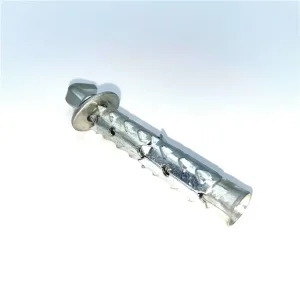
Advanced fish scale expansion bolts, trapezoidal roofing fixtures, multi-combination hardware, and heavy-duty structural attachments.