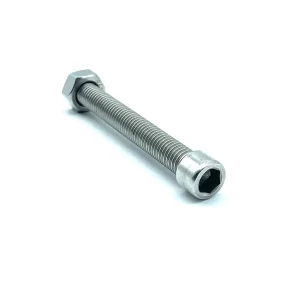
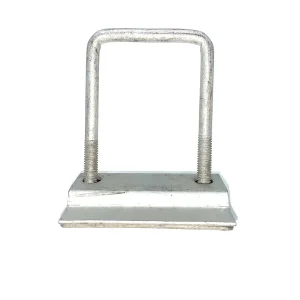
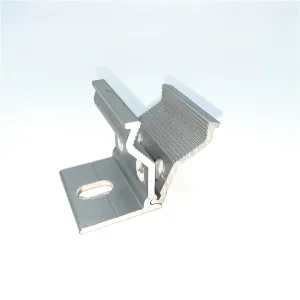
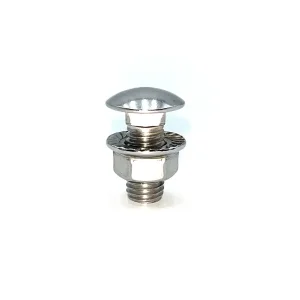
Structural Anchors & Solar Mounting Hardware: Primary Inventory
Explore precision-manufactured photovoltaic hardware, high-tensile connection assemblies, and anchoring products engineered directly in Yongnian, Handan.
Global Commercial & Industrial Status of All Thread Anchor Bolts
Examining critical shift patterns across civil infrastructure, foundation engineering, and the technical supremacy of continuously threaded tension rods.
In contemporary structural engineering, All Thread Anchor Bolts (also designated as continuously threaded anchor rods, full-thread foundation studs, or DIN 976 threaded rods) represent the foundational baseline for load transfer between superstructure framing and concrete substructures. Unlike conventional headed bolts (such as hex-head or square-head cast-in-place fasteners), all-thread anchor rods provide uninterrupted helical thread profiles along their entire axial length. This geometric continuity grants structural designers and geotechnical contractors unprecedented flexibility in setting embedment depths, accommodating variable grout-pad clearances, and utilizing chemical epoxy or adhesive anchoring reservoirs without requiring standardized shank-to-thread transitions.
On a global commercial scale, the consumption of structural all-thread anchoring systems is expanding rapidly, fueled by utility-scale renewable energy installations (solar ground mounts, trackers, and wind turbine foundation rings), seismic retrofits across seismically active zones (under ACI 318 Chapter 17 criteria), and massive heavy-industrial logistics developments. Structural engineers increasingly mandate specifications such as ASTM F1554 (Grades 36, 55, and 105), ASTM A193 (Grade B7, B8, B8M), and metric international classes ISO 898-1 Class 8.8, 10.9, and 12.9. Continuous threading mitigates localized stress concentrations often observed at the shank-to-thread runout of partially threaded fasteners, thereby enhancing cyclic fatigue endurance and load-shedding capabilities under dynamic wind oscillation and seismic ground acceleration.
Full-Length Mechanical Engagement
Provides uninterrupted mechanical interlock along the entire embedded concrete length, optimizing chemical adhesive bond stresses ($τ_{bond}$) and facilitating double-nut anchor base configurations with leveling nuts.
Optimized Bond AreaElimination of Shank Stress Concentration
Partially threaded rods experience severe notch sensitivity at the transition fillet. All-thread geometry ensures a uniform elastic-plastic modulus distribution across the full tensile stress area ($A_s$), reducing sudden brittle fatigue fracture.
Fatigue ResistantUniversal Field Adjustability
Field civil crews can cut, sleeve, weld (under ASTM F1554 Grade 55 weldable specifications), or post-tension full-thread studs on site without thread loss, compensating for uneven foundation pours or elevation re-alignments.
EPC Cost ReductionChinese Manufacturing Ecosystem & Factory Efficiency Advantages
How the Yongnian Fastener Industrial Cluster in Handan delivers unparalleled economies of scale, metallurgy control, and rapid production velocity.
China produces over 55% of the world's structural carbon steel and alloy industrial fasteners. At the core of this industrial supremacy lies Yongnian District, Handan City, Hebei Province—internationally recognized as the "Fastener Capital of China." Handan Youlong Fastener Co., Ltd. capitalizes on this concentrated industrial ecosystem to create an end-to-end, vertically integrated manufacturing operation that overseas standalone fabricators cannot match in either lead times or unit economics.
The efficiency of Chinese anchor bolt manufacturing rests on four fundamental industrial pillars:
Upstream Metallurgical Integration
Direct supply corridors from domestic steel giants (such as HBIS Handan Iron & Steel) supply high-grade raw wire rod (Q235B, 45# carbon steel, 40Cr, 42CrMoA, 304/316 stainless) with certified chemistry melts and minimal logistics overhead.
Planetary Thread Rolling Automation
Utilizing high-speed cylindrical two-die and three-die planetary thread rolling machines. Rolling cold-forms threads under continuous compressive stresses, preserving steel grain flow line integrity and boosting thread fatigue limits by up to 25% over cut threads.
Continuous In-Line Heat Treatment
Equipped with mesh-belt controlled-atmosphere quenching and tempering furnaces. Precise carbon-potential atmospheres eliminate surface decarburization, ensuring consistent hardness (HRC 22–32 for Grade 8.8; HRC 32–39 for Grade 10.9).
Automated Galvanizing Clusters
Close operational access to high-capacity hot-dip galvanizing and environmentally certified zinc-nickel / Dacromet coating lines. Ensures unified ISO 1461 and ASTM A153 coating thicknesses from 45 μm to over 85 μm with zero micro-cracking.
Heavy-Duty Localized Application Scenarios
Analyzing the performance profile of full-thread foundation anchor rods across harsh environmental and mechanical interfaces.
1. Photovoltaic Farm Foundation Piers
In large-scale solar installations, rammed-post steel piles or pre-cast concrete ballast piers utilize all-thread anchor rods (typically M16 to M27 or 5/8" to 1-1/8") to anchor tracking drive pedestals and fixed-tilt brackets. In alkaline or saline soils, continuous threading combined with hot-dip galvanizing or epoxy coatings prevents subsurface crevice corrosion while counteracting cyclic high-wind uplift moments ($M_u$) that exceed hundreds of kilonewton-meters.
2. Wind Turbine Foundation Base Rings
Onshore and offshore wind turbine generator (WTG) gravity base foundations demand ultra-high-strength anchor cage assemblies. High-tensile all-thread bolts conforming to Class 10.9 (42CrMoA) or ASTM A193 B7 are pre-tensioned to 70% of their proof stress. Full threading accommodates the massive circular flange clamping plates and allows precision torque-angle hydraulic tensioning with zero thread-runout bind.
3. Pre-Engineered Building (PEB) Structural Columns
Industrial steel warehouses and crane runway column bases rely on dual-nut leveling systems installed with all-thread anchor bolts. The lower leveling nuts set exact base-plate elevations prior to non-shrink cementitious grouting, while top double-nuts resist intense seismic overturning moments and dead-load shear vectors governed by AISC 360 design rules.
Metallurgical Classifications & Mechanical Performance Matrices
Comparative structural matrix covering North American (ASTM) and International (ISO/DIN) anchor bolt designations.
| Standard & Grade | Material / Chemistry | Yield Strength ($f_y$ min) | Tensile Strength ($f_u$ min) | Elongation ($A$ min) | Target Industrial Application |
|---|---|---|---|---|---|
| ASTM F1554 Grade 36 | Low Carbon Steel (A36 equiv.) | 36 ksi (248 MPa) | 58 – 80 ksi (400 – 550 MPa) | 23% | Standard light structural anchoring, base plates, lighting poles. |
| ASTM F1554 Grade 55 | Micro-alloyed / Weldable Carbon | 55 ksi (380 MPa) | 75 – 95 ksi (517 – 655 MPa) | 21% | Utility solar racking foundations, wind brace footings, highway sign frames. |
| ASTM F1554 Grade 105 | Quenched & Tempered Medium Carbon / Alloy | 105 ksi (724 MPa) | 125 – 150 ksi (862 – 1034 MPa) | 15% | Heavy industrial shear walls, moment frames, crane anchorages. |
| ISO 898-1 Class 8.8 | Medium Carbon Boron / 45# / 40Cr Q&T | 640 MPa (93 ksi) | 800 – 1000 MPa (116 – 145 ksi) | 12% | Worldwide EPC structural steelwork, machinery base plates. |
| ISO 898-1 Class 10.9 | Alloy Steel (40Cr / 42CrMo4) Q&T | 940 MPa (136 ksi) | 1040 – 1200 MPa (151 – 174 ksi) | 9% | Wind turbine tower cages, dynamic vibration equipment, offshore platforms. |
| Stainless 316 / A4-70 / A4-80 | Austenitic Stainless (Cr-Ni-Mo) | 450 – 600 MPa (65 – 87 ksi) | 700 – 800 MPa (101 – 116 ksi) | 16% | Coastal solar arrays, marine jetties, chemical desulfurization plants (C5-M). |
Global Technological Trends & Advanced Surface Metallurgy
Examining breakthroughs in corrosion resistance, digital mill tracking, and hydrogen embrittlement prevention.
Zinc Flake & Eco-Friendly Sherardizing
While traditional Hot-Dip Galvanizing (HDG per ASTM A153 / ISO 1461) remains the baseline for outdoor foundations, micro-thin non-electrolytically applied Zinc Flake coatings (e.g., Geomet, Dacromet) are increasingly specified for Grade 10.9 and ASTM F1554 Grade 105 rods. Because zinc-flake deposition eliminates acidic pickling and electro-deposition currents, the risk of catastrophic Hydrogen Embrittlement (HE) is virtually eliminated while sustaining over 1,500 hours of Neutral Salt Spray resistance.
Duplex Stainless Steel Transition (2205 / 2507)
In near-shore solar carports, floating PV moorings, and coastal chemical refining docks, standard 304 and 316 grades suffer from chloride-induced stress corrosion cracking (SCC). Forward-thinking engineering firms are adopting 2205 Duplex Stainless Steel all-thread anchor bolts, which combine high mechanical yield properties ($f_y \ge 450 \text{ MPa}$) with a Pitting Resistance Equivalent Number (PREN) > 35, ensuring a 50+ year maintenance-free design lifespan.
Digital Heat-Number Traceability & Smart MTRs
Modern EPC contracts require strict component provenance. Youlong integrates direct continuous dot-peen or laser head stamping with QR-linked Mill Test Reports (MTRs per EN 10204 3.1). Procurement teams verify real-time ladle chemistry, tensile yield elongation charts, and Charpy V-notch impact energies down to -40°C directly on their field tablet devices.
International Sourcing Strategy & EPC Audit Protocol
A rigorous quality control verification framework for supply chain directors, QA/QC engineers, and project developers.
Sourcing high-volume all-thread anchor bolts directly from Chinese manufacturers requires an ironclad quality verification process. Sub-standard fasteners manufactured with reclaimed scrap steel or improper thread rolling dies can cause disastrous brittle shear failures during concrete cure or severe foundation pullout under wind loads. Leading global procurement entities enforce the following 5-point verification audit:
1. Steel Billet Provenance & Chemistry
Mandate primary blast-furnace hot-rolled wire rod billets. Confirm low sulfur ($S \le 0.025\%$) and phosphorus ($P \le 0.025\%$) contents on the EN 10204 3.1 MTR to prevent intergranular micro-cracking during cold heading and rolling.
Chemistry Audit2. Thread Form & Pitch Diameter Gauging
Verify Class 2A (unified inch) or 6g (metric) thread fits using calibrated Go / No-Go pitch rings. Hot-dip galvanized rods must be certified as rolled-undersized prior to coating or smoothly re-chased using standardized oversize taps per ASTM A563.
Dimensional Tolerance3. Destructive Tensile & Charpy V-Notch Testing
Independent third-party batch sampling (SGS, TÜV, BV) conducting full-size wedge tensile rupture testing and sub-zero Charpy impact testing (e.g., min. 27 J at -20°C or -40°C) to guarantee structural ductility in extreme cold-climate installations.
Mechanical Integrity4. Coating Thickness & Adhesion Verification
Electromagnetic or eddy-current coating thickness measurements per ASTM B499. Ensure minimum zinc mass per square meter meets project specifications (e.g., $\ge 610 \text{ g/m}^2$ for ASTM A153 Class C) without zinc drips or clogging in root threads.
Corrosion Control5. Anti-Embrittlement Heat Relief Documentation
For rods exceeding 1,000 MPa tensile strength (Class 10.9 or ASTM F1554 Gr 105), confirm baking furnace logs (typically 190°C – 220°C for 4 to 8 hours immediately post-electroplating or acid exposure) to eliminate atomic hydrogen entrapment.
Zero EmbrittlementFrequently Asked Questions on All Thread Anchor Bolts
In-depth responses to critical engineering, manufacturing, and procurement inquiries from overseas buyers.
What are the definitive engineering distinctions between cut threads and rolled threads on all-thread anchor rods?
How do you calculate the minimum embedment depth ($h_{ef}$) for all-thread anchor bolts in concrete foundations?
Can ASTM F1554 Grade 55 or Grade 105 all-thread anchor bolts be safely welded on site?
How do you prevent galvanic corrosion between aluminum solar racking bases and galvanized steel anchor bolts?
What are the maximum lead times and container loading capacities from Handan Youlong Fastener factory?
Precision Fasteners, Brackets & Roof Clamps: Complete Catalog
Direct manufacturer-tier supply for EPC contractors, balance-of-system integrators, and global industrial distributors.