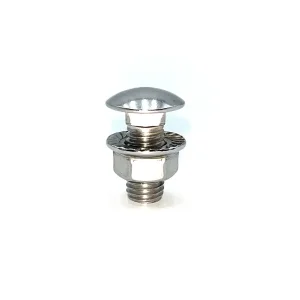
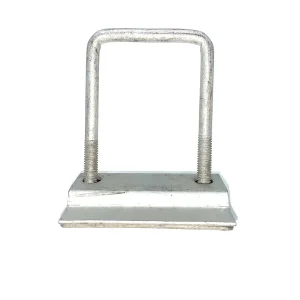
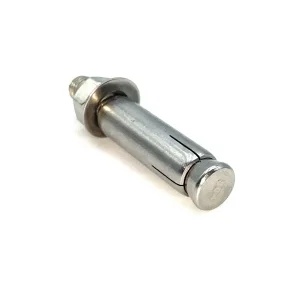
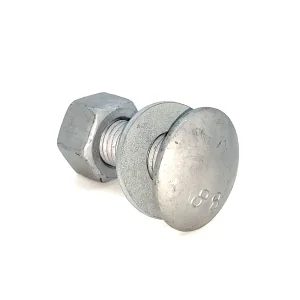
Precision Bolts & Ground Structural Mounts
Engineered to resist harsh atmospheric, marine, and seismic loads with certified metallurgical composition.
The Paradigm Shift in Black Galvanized Fasteners
Analyzing microstructural metallurgy, conversion coatings, and anti-reflective aesthetics for modern infrastructure.
Dual-Action Corrosion Barrier
Standard zinc galvanizing provides sacrificial cathodic defense, but in aggressive chemical environments, sacrificial breakdown occurs rapidly. Modern black galvanized bolts integrate a hot-dip zinc matrix sealed with a cross-linked trivalent black passivate (and micro-thin organo-mineral topcoats). This synergetic shield extends ASTM B117 salt spray ratings upwards of 1,200 to 1,500 hours without red rust nucleation.
Glare Attenuation in Solar Arrays
Utility-scale Photovoltaic (PV) plants, agro-voltaic structures, and aviation-adjacent solar farms face strict anti-glare mandates (FAA compliance). Traditional silvery zinc finishes generate specular reflectance that impairs ocular safety and air monitoring. The optical absorption profile of a precision matte-black zinc surface eliminates 94% of incident glare without degrading mechanical pre-load torque properties.
Micro-Crack Mitigation & Torque Uniformity
High-tensile Grade 8.8, 10.9, and ASTM A325 fasteners are intrinsically vulnerable to Hydrogen Embrittlement (HE) during acid pickling and electro-conversion. State-of-the-art manufacturing adopts mechanical descaling followed by regulated de-embrittlement thermal baking (200°C–230°C for 8+ hours) and lubricated silicate topcoats that stabilize torque-tension coefficients (k-factor = 0.12–0.16).
Corporate Procurement Needs in Capital Infrastructure
Addressing supply-chain risk mitigation, mill-traceability, and lifecycle operational cost reduction.
25-Year Asset Life Alignment
Global developers cannot accept structural refits at year 7 on a 25-year lifecycle solar farm or offshore substation. Procurement directors demand hardware that tracks environmental degradation curves seamlessly, aligning corrosion rate warranties with the asset's financial amortization timeline.
Full Mill Lot Traceability (EN 10204 3.1)
Structural liabilities dictate complete metallurgical tracking. Leading engineering firms verify 100% heat-lot traceability, spectrum chemical spectrometry, yield vs tensile strain margins, and Charpy V-notch impact testing at sub-zero thresholds (-40°C) directly through verifiable inspection dossiers.
Pre-Engineered Kitting & Fastener Logistics
Site installation labor costs dominate EPC balance sheets. Procurement models now specify custom kitting—matching black galvanized bolts, serrated flange nuts, and EPDM isolation washers pre-packaged by mounting frame coordinate—accelerating field deployment times by up to 32%.
| Coating Specification | Typical Thickness | Salt Spray Resistance (ASTM B117) | Hydrogen Embrittlement Risk | Ideal Application Domain |
|---|---|---|---|---|
| Hot-Dip Galvanized + Black Topcoat | 45 – 65 µm | 1,500+ Hours | Extremely Low (Thermal Descaling) | Utility Solar, Coastal Trackers, Highway Noise Barriers |
| Black Oxide over Plain Steel | 1 – 2 µm | 24 – 48 Hours | Negligible | Indoor Tooling, Dry Enclosed Machinery |
| Black Zinc Electroplating | 8 – 15 µm | 120 – 240 Hours | Moderate (Mandatory Bakeout) | Light Electronics Brackets, Automotive Cabin Trim |
| Zinc Flake + Black Organic Seal | 12 – 25 µm | 1,200 – 2,000 Hours | Zero (Non-Electrolytic Process) | Wind Turbine Nacelles, Heavy Mining Equipment |
Macro-Industry Solutions & Engineering Roadmap
The manufacturing progression towards eco-compliant hexavalent-free chemistries and automated sensorized joints.
RoHS & REACH Eco-Chemistries
Global environmental mandates prohibit toxic Hexavalent Chromium (Cr6+) in surface finishing. Modern industrial production lines enforce Cr3+ conversion chemistry combined with waterborne nano-silicate sealers, delivering equal self-healing barrier performance with zero persistent hazardous effluent discharge.
Galvanic Decoupling on Hybrid Assemblies
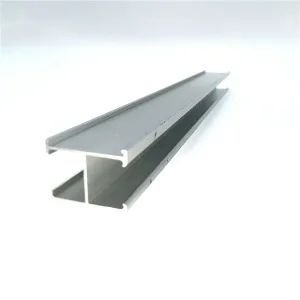
Direct contact between black galvanized carbon steel bolts and 6005-T6 aluminum photovoltaic rails can trigger intense galvanic micro-cells in coastal marine environments (C5). Engineering protocols specify integrated fluoropolymer coatings or integrated vulcanized EPDM isolators to break electrical continuity.
Smart Tension-Indicating Fasteners
The roadmap for critical heavy infrastructure includes direct tension indicators (DTIs) and integrated piezo-resistive sensor micro-chips embedded in the bolt cap. This allows remote maintenance crews to inspect bolt clamping tensions on utility solar trackers via handheld RFID scanners without physical wrench calibration.
Frequently Asked Engineering & Procurement Questions
Addressing crucial specifications, corrosion kinetics, and custom structural applications.
What is the technical difference between black galvanized and black oxide bolts?
Black oxide is a micro-thin (1-2 micron) chemical conversion that offers minimal corrosion defense (24 to 48 hours salt spray) suited primarily for indoor machinery. Black galvanized bolts incorporate a true protective zinc foundation (HDG or zinc-nickel, 15 to 55 microns) topped with an organic or passivated black sealer, providing 1,000+ hours of ASTM B117 outdoor salt-spray longevity.
How do you eliminate hydrogen embrittlement in Grade 10.9 black bolts?
High-strength steels (≥1000 MPa tensile strength) are susceptible to atomic hydrogen trapping during acid pickling. We use mechanical blast cleaning (wheelabrating) instead of aggressive acid dipping, followed immediately by certified post-coating thermal de-embrittlement baking at 200°C–220°C for a minimum of 8 hours in accordance with ISO 9588 specifications.
Can black galvanized bolts be paired with aluminum solar mounting rails?
Yes, but galvanic compatibility must be accounted for. While the black topcoat acts as a non-conductive dielectric barrier that limits galvanic coupling, best engineering practices for ISO C4/C5 coastal zones require UV-stabilized EPDM flat washers or nylon sleeves to prevent direct cathodic interaction between the steel bolt core and aluminum frame.
What quality certification documents accompany factory-direct shipments?
Every commercial production batch is supplied with an EN 10204 3.1 Inspection Certificate. This includes chemical heat analysis, core/surface hardness checks (HRC/HRB), proof load and tensile rupture verification, coating thickness verification via XRF spectrometry, and salt spray test certificates.
Heavy-Duty Infrastructure Fasteners & Brackets
Comprehensive anchor hardware, structural carriage assemblies, and corrosion-resistant fasteners.