Catalog Highlights: Structural Fastening Systems
Factory-direct industrial fasteners, solar structural hardware, and heavy-duty anchoring profiles produced in Handan.
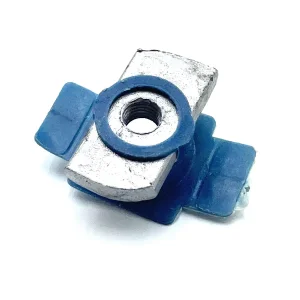
Structural Mechanics of M8 Flanged Nyloc Nuts (DIN 6926 / EN 1663 / ISO 7043)
Combining the anti-loosening resilience of a non-metallic insert with the integrated bearing distribution of an annular flanged skirt.
Prevailing Torque Mechanics
The core advantage of an M8 flanged nyloc nut is its captive Polyamide 6.6 (Nylon) locking ring. As an M8 external thread engages the unthreaded collar, it elastically deforms the polymer rather than cutting it. This radial interference creates constant friction without destroying fastener thread interfaces.
Flanged Surface Load Distribution
By integrating a solid flange directly onto the hexagonal body, these nuts double the bearing contact area compared to standard DIN 985 nuts. This distributes surface clamp pressure evenly, preventing localized deformation on soft strut metals like 6005-T6 aluminum solar rails.
Vibration & Harmonic Immunity
In high-vibration applications—such as dual-axis solar trackers, HVAC cooling modules, and wind nacelles—transverse harmonic motion causes standard bolted connections to back out. Nyloc configurations retain clamp preload past 30,000 harmonic cycles in ISO 16130 Junker testing.
| Dimensional / Mechanical Parameter | DIN 6926 Specification | EN 1663 / ISO 7043 Equivalence | Youlong Quality Control Benchmark |
|---|---|---|---|
| Nominal Thread Pitch (P) | 1.25 mm (Coarse Metric) | 1.25 mm (Coarse Metric) | 6H Ring Gauge Tolerance (100% Go/No-Go) |
| Flange Diameter (dc max) | 17.90 mm | 17.90 mm | 17.65 mm – 17.85 mm Optically Verified |
| Width Across Flats (s max) | 13.00 mm (Hex Drive) | 13.00 mm | 12.73 mm – 13.00 mm Automated CNC Sorting |
| Prevailing Nut Height (m min) | 9.40 mm | 11.10 mm (Total Height h) | High-profile cold-headed body control |
| First Prevailing Torque (Min) | 4.0 N·m (ISO 2320 Class 8) | 4.0 N·m | ≥ 4.5 N·m Consistent Polymer Insertion |
| Fifth Removal Torque (Min) | 0.6 N·m (ISO 2320 Class 8) | 0.6 N·m | ≥ 0.85 N·m Retained Prevailing Friction |
| Temperature Working Range | -50°C to +120°C | -50°C to +120°C | Hydrolysis-stabilized virgin PA66 rings |
Why Sourcing from China's Fastener Capital Gives EPCs a Strategic Edge
A deeper look into Yongnian District’s hyper-concentrated raw material access, precision tooling ecosystem, and global export infrastructure.
Integrated Upstream Metallurgy
Yongnian companies sit next to Hebei's primary steelmakers. Direct procurement of Q235B, 35K, 45# carbon steels, and 304/316 austenitic stainless cold-heading wire rods eliminates intermediary logistics markups and stabilizes production schedules.
Multi-Station Cold Heading Lines
Chinese fastener factories operate high-speed 5-stage and 6-stage progressive cold formers. These automated forming lines stamp the hex shape, cold-extrude the integrated flange, and tap threads in a continuous sequence, delivering high-volume output at low piece costs.
Economies of Scale & Tooling
With cumulative shipments exceeding 300,000 tonnes, Handan Youlong leverages amortized tooling, continuous-mesh belt heat treatment furnaces, and automated nylon ring insertion equipment to handle massive utility-scale supply volumes.
Tianjin Port Logistics Synergy
Situated within overnight transit to Tianjin Xingang Port, factories coordinate containerized multimodal shipments with rapid export clearance, handling bill of lading issuance, Fumigation Certificates, and Form E/CO documentation smoothly.
Navigating International Quality Standards and Regulatory Compliance
Comprehensive engineering traceability from Mill Test Certificates (EN 10204 3.1) to European and North American anti-corrosion benchmarks.
ISO 9001:2015 & CE Verification
Global project tenders require total procedural transparency. Manufacturing protocols ensure dimensional inspection, mechanical hardness validation (Rockwell/Vickers), and proof load testing comply directly with CE CPR 305/2011 and EN 15048 standards for non-preloaded structural bolting assemblies.
RoHS, REACH & Polymer Stability
The captive non-metallic collar must remain compliant with EU REACH Annex XVII and SVHC candidates. Youlong specifies non-recycled PA66 inserts, guaranteeing no prohibited flame retardants or plasticizers while preserving UV resistance during 25+ years of outdoor solar exposure.
Salt Spray & Anti-Galling Protection
For coastal solar and marine arrays, M8 A2-70 and A4-80 nuts undergo chemical passivation to enhance their chromium-oxide boundary layer. In addition, specialized wax or MoS2 anti-friction coatings prevent cold-welding and thread galling during high-speed pneumatic installations.
Evolving Engineering Trends in Fastening Technology
From zinc-nickel coatings to high-speed installation robotics, structural hardware is evolving to keep pace with changing project demands.
Zinc-Nickel & Flake Coatings
While traditional hot-dip galvanizing provides thick sacrificial barriers, thread fit clearances for M8 metric nuts can become compromised. Modern projects are shifting toward electroplated Zinc-Nickel (ZnNi) and non-electrolytic Zinc Flake (Geomet/Dacromet) coatings, which deliver 1,500+ hours of ASTM B117 salt spray protection without altering standard thread tolerances.
Automated & Robotic Assembly
Fast installation turnaround is essential for multi-megawatt renewable sites. M8 flanged nyloc nuts eliminate the need for a separate flat washer and lock washer, allowing automated vibratory hopper feeds and automated nut-runners to seat bolted joints up to 40% faster on the installation line.
Lightweight High-Tensile Alloys
Next-generation racking designs place a premium on system weight reduction. Chinese manufacturers are expanding production in Grade 10.9 boron steels and high-strength A4-80 stainless alloys, providing higher yield strengths in compact M8 profiles to handle extreme typhoon and seismic wind load scenarios.
Critical Deployment Scenarios for M8 Flanged Self-Locking Fasteners
Where dynamic loads, environmental exposures, and mechanical fatigue demand zero-failure locking integrity.
Utility-Scale Solar Racking & Trackers
M8 flanged nyloc nuts are widely specified across tracker linkage joints, torque tube saddles, purlin splices, and module mid/end clamp bolt assemblies. Their self-locking prevailing collar resists long-term buffeting from crosswinds without loosening over the system's operating life.
Wind Power Nacelle Subsystems
Inside the nacelle and hub enclosures of wind turbines, ongoing mechanical vibration is unavoidable. M8 prevailing torque nuts secure internal electrical wire trays, hydraulic control modules, and protective covers, preventing loose hardware from falling into rotating gear sets.
Commercial EV & Rail Transportation
In electric bus chassis, rail car interior panels, and heavy-duty battery enclosure mounting frames, the integrated flange spreads clamping loads across sheet metal assemblies, keeping structural joins tight through repeated road vibration and thermal cycling.
Frequently Asked Questions: Global Buyer Technical Guide
Essential guidance on prevailing torque, coating options, thermal limits, and bulk procurement logistics.
Complementary PV Mounting Hardware & Foundation Fasteners
Complete structural connection solutions from foundation expansion bolts to rooftop clamping components.