
Featured Heavy-Duty Connectors & High-Tensile Hardware
Explore our factory-direct hardware combinations engineered for structural mechanical reliability, utility-scale solar PV mounting arrays, and high-vibration commercial installations.
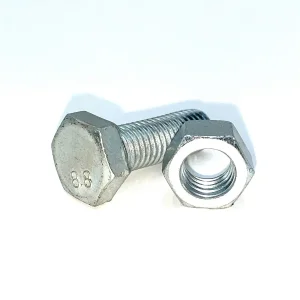
Executive Metallurgy & Structural Mechanics: Grade 8.8 Fasteners
A deep technical analysis of ISO 898-1 and DIN 912 compliance, load distribution behavior, quench-and-temper hardening, and mechanical durability in high-demand industrial systems.
Nominal Tensile Strength: 800 MPa
The "8" prefix denotes a minimum nominal ultimate tensile strength (UTS) of 800 N/mm² (MPa). Under extreme axial tensile stresses, Grade 8.8 alloy steel cap screws guarantee reliable clamp force retention without brittle fracture, making them the standard choice for dynamic mechanical joints and structural mounts.
Yield Ratio & Elastic Limit: 640 MPa
The secondary ".8" multiplier signifies an 80% yield strength ratio, providing a verified elastic limit of 640 N/mm². This structural threshold ensures the fastener remains purely in its elastic deformation zone under variable operating loads, absorbing vibrational cyclic shock without permanent elongation.
Quenched & Tempered Medium Carbon Alloy
Fabricated through precision cold forging from selected medium carbon steel (AISI 1035/1045) or low-alloy boron steel (such as 10B21 / 40Cr), then thermally processed through continuous mesh belt furnace lines to achieve a consistent Core Rockwell Hardness of 22 to 32 HRC (Vickers 250–320 HV).
| Property / Characteristic | Grade 8.8 Metric Specification | Governing Engineering Standard | Engineering Practical Relevance |
|---|---|---|---|
| Nominal Tensile Strength (Rm) | 800 N/mm² (MPa) min. | ISO 898-1 | Ensures high-load structural capacity under extreme wind loads and mechanical torque. |
| Proof Load Stress (Sp) | 580 – 600 N/mm² (MPa) | DIN EN ISO 898-1 | Maximum design pre-load stress applied without inducing permanent mechanical set. |
| Yield Strength (Re / Rp0.2) | 640 N/mm² (MPa) min. | DIN 912 / ISO 4762 | Critical elastic boundary prevents hardware joint loosening under thermal expansion. |
| Elongation After Fracture (A) | 12% min. | ASTM F568M | Prevents catastrophic sudden shear failures by providing ductile strain buffer. |
| Surface Hardness & Core Hardness | Core: 22–32 HRC / Surface: ≤ 30 HV0.3 above core | ISO 6508 / ISO 6507 | Eliminates brittle surface carburization while resisting wear and socket reaming. |
| Impact Toughness (Charpy V-Notch) | ≥ 30 Joules at -20°C | ISO 148-1 | Verified low-temperature performance for sub-zero desert, polar, or wind turbine installations. |
Global Commercial Landscape: Handan Fastener Ecosystem
Why engineering procurement executives, EPC conglomerates, and international distributors consolidate their Grade 8.8 supply lines within Yongnian, Handan — the world's most dense fastener cluster.
Integrated Raw Material Inflow
Positioned next to northern China's premier steel manufacturers (such as HBIS Group), Youlong ensures rapid direct mill supply of high-purity alloy cold-heading steel wire rod with rigorous chemical homogeneity checks.
Continuous Heat Treatment
Internal multi-zone atmospheric mesh belt furnaces ensure complete martensitic transformation during oil quenching, followed by precise high-temperature tempering to eliminate residual thermal tensions and prevent micro-cracking.
Optical Sorting & Zero Defect
Equipped with laser and multi-camera optical sorters checking dimensional tolerances, thread pitch integrity, head eccentricity, and socket depth at speeds up to 800 pieces per minute, delivering zero-defect batches.
Direct Deep-Sea Port Logistics
Direct bonded warehousing with rapid transit to Tianjin Port and Qingdao Port allows streamlined full-container load (FCL) dispatches, reducing intermediate shipping dwell times and mitigating port demurrage surcharges.
Precision fasteners and structural mounting components shipped globally.
EPC contractors, PV racking fabricators, and machinery OEMs served worldwide.
Specialized in solar photovoltaic mounting systems and high-tensile hardware.
Salt spray chamber endurance achieved with advanced Geomet and Dacromet coatings.
Compliance Safeguards, Testing & Localized Technical Support
We eliminate international sourcing risks through verified metallurgical traceability, rigorous physical test reports, and regional technical compliance standards.
EN 10204 Type 3.1 Traceability
Every shipment is backed by an authenticated Mill Test Certificate (MTC) detailing complete chemical heat analysis (C, Si, Mn, P, S, Cr, B) and verified mechanical proof load, core hardness, and tensile elongation metrics mapped to heat lot numbers.
Hydrogen Embrittlement Baking
For electro-galvanized or zinc-plated Grade 8.8 and high-hardness cap screws, strict de-embrittlement baking is conducted at 200°C ± 5°C for 4 to 8 hours immediately post-electroplating per ISO 4042, eliminating atomic hydrogen traps.
Custom Engineering & OEM Tooling
Full customization covering non-standard shank lengths, specialized undercut heads for low-clearance robotic joints, vented center holes for vacuum semiconductor chambers, and customized socket depths according to client drawings.
Strategic Engineering Application Scenarios
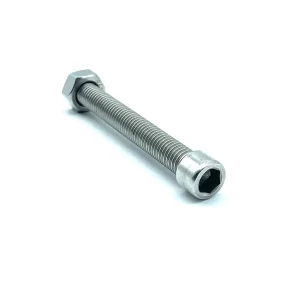
Where spatial geometry restrictions, dynamic cyclical torque, and severe environmental stresses demand Grade 8.8 Hexagon Socket Head Cap Screws.
Solar Trackers & Heavy Racking
Single-axis and dual-axis solar tracking arrays experience heavy dynamic wind torsional buffeting. Grade 8.8 socket head cap screws secure slewing drive gearboxes, torque tube brackets, and pivot bearings without loosening or head deformation.
CNC Tooling & Mold Fixtures
With cylindrical head profiles counterbored flush into machine beds, Grade 8.8 socket screws eliminate external interference in precision stamping dies, automated tool changers, and high-speed multi-axis linear rail guides.
Hydraulic Valves & Flanges
High-pressure fluid transmission systems require uniform bolt preloading across circular flange seals. The internal hex drive accommodates calibrated torque wrenches in cramped recesses where standard external hex sockets cannot fit.
EV Powertrain & Battery Frames
Automotive battery enclosures, inverter casings, and drivetrain mounts depend on Grade 8.8 structural cap screws treated with non-electrolytic zinc flake coatings to combine structural crashworthiness with lightweight spatial efficiency.
Technology Roadmap & Industry Trends (2025–2030)
How advanced metallurgical forming, digital quality tracking, and green decarbonization coatings are shaping the future of industrial fastening technology.
Zero-Decarburization Heat Treat
Integration of intelligent oxygen probe control systems inside sealed quenching atmospheres, completely eliminating surface decarburization, maximizing fatigue life under dynamic cyclical loads.
Hexavalent-Free Eco Coatings
Complete phase-out of legacy chromates in favor of ultra-thin, nano-structured zinc-flake and inorganic silicates delivering 1,500+ hours C5-M marine corrosion resistance compliant with EU CBAM carbon tariffs.
Digital Batch-Level QR Traceability
Laser marking of micro-QR codes directly onto bolt heads for safety-critical wind power and utility solar structures, instantly pulling complete chemical, forging, and torque inspection records via mobile scan.
Cold-Formed High-Speed Precision
Adoption of 6-station high-speed progressive cold-forming multi-blow headers producing complex internal socket cap geometries with zero metal cutting waste and unbroken grain boundary flow lines.
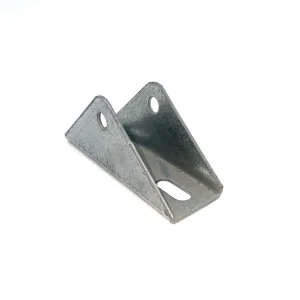
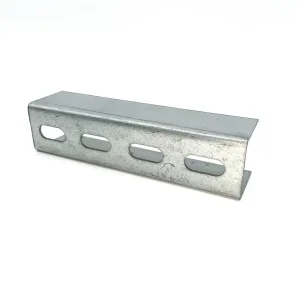
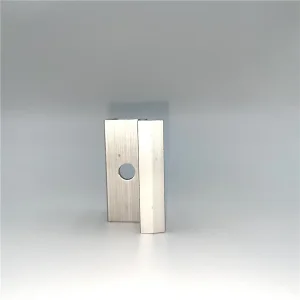
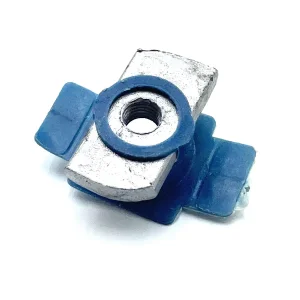
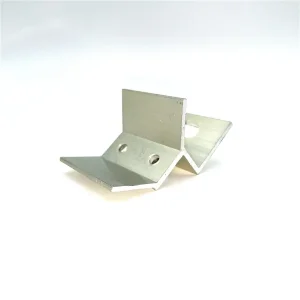
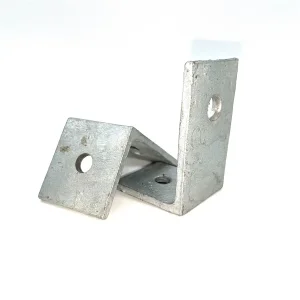
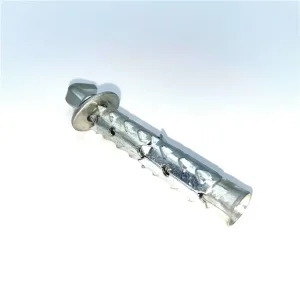
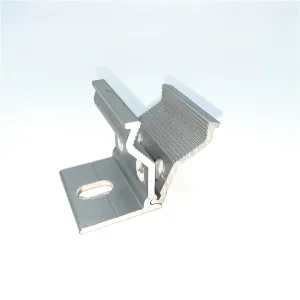
Complete Assembly Fasteners, Clamps & Structural Anchors
Factory-matched accessories engineered to interface seamlessly with your Grade 8.8 cap screw assemblies and solar PV infrastructure.
High-Intent Engineering & Sourcing Questions (Q&A)
Answers to critical questions regarding torque ratings, surface treatments, hydrogen embrittlement, and material comparisons for procurement teams.
What is the structural difference between Grade 8.8 and Grade 10.9 or 12.9 Socket Head Cap Screws?
Grade 8.8 provides a nominal tensile strength of 800 MPa and a yield limit of 640 MPa with minimum 12% elongation. Grade 10.9 provides 1,000 MPa tensile and 900 MPa yield, while 12.9 delivers 1,200 MPa tensile. While 10.9 and 12.9 offer higher clamp forces in static environments, Grade 8.8 features superior ductility and impact toughness, making it far less vulnerable to hydrogen embrittlement and catastrophic stress-corrosion cracking (SCC) under outdoor or coastal cyclic loading conditions.
How do you calculate proper tightening torque (Pre-load) for Grade 8.8 Hexagon Socket Cap Screws?
Torque is calculated using the formula T = K × d × F, where T is the tightening torque (N·m), d is the nominal bolt diameter (m), F is the target clamping preload (typically 70% to 75% of proof load), and K is the nut factor (torque coefficient). For standard lightly oiled or black oxide finishes, K ranges between 0.18 and 0.20; for zinc flake (Geomet/Dacromet) coatings with integrated lubricants, K is held tightly between 0.12 and 0.15. For example, a dry M10 Grade 8.8 screw requires ~48 N·m, whereas lubricated zinc flake requires ~36 N·m to achieve identical clamp load.
What surface treatment is recommended for Grade 8.8 cap screws in outdoor solar mounting systems?
For utility-scale solar PV and outdoor structures, Hot-Dip Galvanizing (ISO 10684, ≥ 45 μm zinc layer) or non-electrolytic Zinc Flake coatings (such as Geomet 321/500 or Dacromet) are strongly recommended over conventional electro-galvanizing. Zinc flake systems eliminate the risk of hydrogen absorption entirely during application and withstand 1,000 to 1,500 hours of neutral salt spray testing (ASTM B117) without red rust, providing a 25+ year outdoor service life matching solar module warranties.
How do you mitigate galvanic corrosion when fastening steel Grade 8.8 screws to aluminum solar rails?
Galvanic coupling occurs when dissimilar metals with distinct electrochemical potentials (steel and aluminum alloy 6005-T5/6063-T6) contact in an electrolyte environment. To prevent localized pitting of the aluminum profile, our engineering team supplies isolating UV-stabilized EPDM flat washers, Dacromet barrier finishes, or stainless steel A2/A4 shim sleeves to electrically decouple the contact faces.
What documentation and certifications are provided with international orders?
Every production lot is provided with an EN 10204 3.1 Inspection Certificate, full chemical composition analysis via optical emission spectroscopy (OES), tensile and yield test graphs, Rockwell core hardness logs, salt spray test reports (ISO 9227), and RoHS/REACH compliance declarations. Custom third-party inspection audits (SGS, TÜV Rheinland, Bureau Veritas) are facilitated prior to container sealing.