High-Performance Mounting & Expansion Hardware
Verified structural components engineered to interface directly with mechanical expansion anchors across utility-scale photovoltaic racking, structural steel, and solid masonry substrates.
The Global Commercial & Industrial Anchoring Landscape
Analyzing structural demand shifts across North America, the European Union, APAC, and Emerging Energy Corridors.
In modern structural engineering, post-installed anchoring systems represent the foundational interface between unyielding geotechnical concrete substrates and dynamic superstructure assemblies. Among mechanical displacement fasteners, the Single Expansion Anchor has established itself as an indispensable mechanical fixture in light-to-medium and heavy-duty structural anchoring. Driven by exponential global expansions in renewable infrastructure (utility-scale solar racking and wind turbine sub-assemblies), subterranean transit networks, industrial logistics facilities, and civil retrofitting, the global market for mechanical concrete fasteners is experiencing unprecedented technical evolution.
Historically manufactured through basic zinc die-cast or mild carbon steel processes, the modern single expansion anchor now operates under stringent regulatory paradigms including ACI 318 Chapter 17 (Anchoring to Concrete), European Technical Assessment (ETA) regimes, and ASTM E488 Standard Test Methods for Strength of Anchors in Concrete Elements. As engineering procurement teams migrate away from commoditized fasteners toward precision-machined, high-yield alloy anchors, Handan Youlong Fastener Co., Ltd.—situated in the core of China's premier fastener industrial hub in Yongnian District, Handan—has spearheaded this technological transition, deploying advanced multi-station cold-forming, automated internal thread tapping, and robotic optical sorting systems.
Yongnian Industrial Ecosystem: Scale, Vertical Integration, and Supply Security
The geographic concentration of steel making, heat treatment, cold-heading tooling, and electroplating infrastructure in Yongnian affords unique economic and metallurgical advantages. With raw alloy steel wire rod supply directly linked to domestic blast-furnace leaders and specialized secondary rolling mills, Youlong Fastener achieves unmatched batch uniformity, maintaining tight tolerances down to ±0.05 mm across internal expansion cones and external slotted expansion shields.
Single Expansion Anchor Mechanics vs Alternative Post-Installed Fasteners
Understanding internal wedge displacement, radial frictional vectors, and concrete breakout cone geometry.
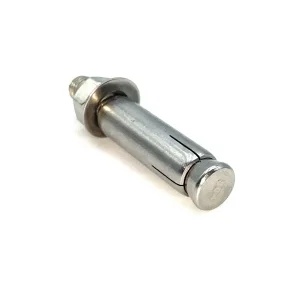
The fundamental operating premise of the single expansion anchor relies on mechanical torque-controlled or displacement-controlled expansion. A single tapered expander cone is threaded onto the machine bolt or drawn longitudinally into a single split expansion sleeve during bolt tensioning. As the conical expander moves axially upward, its increasing outer diameter forces the external tubular shield outwards against the pre-drilled cylindrical sidewalls of the concrete borehole.
This creates localized radial compressive stress fields. For successful anchor design without premature substrate spalling, the tensile capacity ($N_{Rd,c}$) is governed by the projected surface area of the concrete breakout failure cone, determined in accordance with the Concrete Capacity Design (CCD) Method:
| Fastener Typology | Working Mechanism | Tensile Capacity ($N_{rec}$) | Shear Resistance ($V_{rec}$) | Removability / Reusability | Edge Distance Margin | Optimal Concrete State |
|---|---|---|---|---|---|---|
| Single Expansion Anchor | Radial cone expansion into cylindrical slotted shield | Moderate to High | Excellent (Heavy Sleeve) | 100% Flush Flushable | Moderate ($c \ge 10d$) | Uncracked C20/25 - C50/60 |
| Double Expansion Anchor | Dual opposed cones expanding across entire barrel length | High (Distributed) | Moderate to High | 100% Flush Flushable | Reduced ($c \ge 8d$) | Soft Stone / Brick / Porous Concrete |
| Wedge Anchor (Through-Bolt) | Single-piece clip expanding around rolled neck groove | Very High | High (Pin-dependent) | Permanent Stud | Stringent ($c \ge 12d$) | Cracked & Uncracked Solid Slab |
| Chemical / Adhesive Stud | Chemical bonding via vinyl-ester/epoxy resin matrix | Maximum | Maximum | Permanent Thread | Minimal ($c \ge 5d$) | Dynamic / Vibrational Environments |
Why EPC Contractors Prioritize Single Expansion Shields
Unlike standard wedge anchors which leave a threaded stud protruding above the finished concrete floor—creating trip hazards, interfering with skid placement, and complicating machine positioning—the single expansion anchor sits completely flush with the concrete surface. Machinery or photovoltaic support rails can be placed directly over the borehole before inserting the hex head bolt or threaded stud. If structural equipment must be relocated or decommissioned, the bolt can be unthreaded, leaving an unobstructed, flush surface that can be easily grouted.
Localized Engineering Applications & Environmental Categorization
Critical structural use cases where single expansion anchors deliver unmatched mechanical security.
Utility-Scale Photovoltaics & Carports
Mounting aluminum 3040 guide rails, ballast block mounting plates, and purlin connectors to pre-cast or cast-in-place concrete footings. Withstands severe cyclic wind uplift loads and vibrational buffet without cone slippage.
Industrial Machinery & Gantry Racking
Securing high-bay automated warehouse pallet racks, stamping machines, and structural crane rail supports. The single expansion shield absorbs perpendicular shear dynamic cycles while preserving floor integrity.
Seismic & Subterranean Rail Systems
Cable trays, ventilation shafts, fire damper enclosures, and overhead electrification masts fixed into tunnel concrete linings. Certified for seismic performance categories C1 and C2 under strict displacement limits.
Offshore & Coastal C5 Environments
Fabricated in AISI 316 (A4-70/80) austenitic stainless steel to eliminate chloride-induced pitting, intergranular attack, and stress corrosion cracking (SCC) across marine splash zones and wastewater plants.
Structural Steel Envelope Connections
Curtain wall transom brackets, exterior steel canopies, and architectural facade mullions anchored into composite concrete-deck beams, balancing shear and tension vectors under fluctuating thermal conditions.
HVAC, Plumbing & MEP Suspensions
Heavy mechanical chilled water pipe supports, emergency smoke evacuation ducting, and industrial generator isolator bases fixed to overhead slabs where overhead drilling clearance is constrained.
Strict Quality Control & Destructive Laboratory Testing
Ensuring absolute metallurgical integrity from furnace wire rod to calibrated torque setting.
Single expansion anchors are exposed to combined shear and axial tensile fatigue. A defect in the internal cone thread or an uneven wall thickness in the slotted sleeve can cause premature brittle shear failure or catastrophic pull-out slippage. Handan Youlong Fastener executes an end-to-end Quality Assurance protocol certified under ISO 9001:2015:
1. Direct-Reading Optical Emission Spectrometry (OES)
Every wire rod coil (AISI 1008/1010 for cold-formed carbon sleeves, 35CrMo/40Cr for high-strength internal cones, and AISI 304/316 for stainless lines) is analyzed for chemical composition, verifying precise limits on carbon, sulfur, phosphorus, chromium, and nickel content to prevent interstitial cracking during cold-heading expansion.
2. Uniaxial Tensile & Combined Pull-Out Verification (ASTM E488)
Using computerized universal testing machines (UTM) up to 1000 kN capacity, production samples are anchored into cured C25/30 concrete test slabs. Displacement is recorded at 0.1 kN load increments to construct the full Load vs Slip Curve, determining the ultimate tensile load ($N_u$) and verifying that failure occurs via concrete cone breakout rather than sudden anchor body yielding.
3. Cyclic Neutral Salt Spray (NSS) Testing (ISO 9227 / ASTM B117)
To ensure 25+ year design lifetimes for utility solar mounting brackets and building envelopes, electro-galvanized anchors receive trivalent passivations with silica nanocoatings achieving >120 hours to white rust. Mechanically galvanized and hot-dip galvanized (HDG) units exceed 720 to 1,000+ hours to red rust, surpassing ASTM A153 specifications.
Technology Roadmap: Smart Fasteners & Sustainable Metallurgy
How automation, digitalization, and decarbonization are redefining high-performance concrete anchoring.
Integrated Torque-Sensing Sleeves
Development of visual deformation rings and micro-grooved indicators that physically pop or discolor when the prescribed installation torque ($T_{inst}$) has been reached, completely eliminating technician over-torquing and under-expansion errors during field assembly.
BIM Integration & Parametric Digital Twins
Integrating exact 3D parametric CAD models and finite element calculation macros into Autodesk Revit, Tekla Structures, and Bentley OpenBuildings, enabling structural engineers to simulate collision zones and calculate load combinations before breaking ground.
Low-Carbon Recycled Metallurgy (Green Steel)
Implementing electric arc furnace (EAF) processing powered by renewable microgrids in Handan, reducing the embodied carbon footprint ($kg\ CO_2/tonne$) by up to 45% to help Tier-1 EPC clients fulfill strict Scope 3 ESG mandates.
Strategic Factory Audits & Supplier Evaluation Guidelines
Essential criteria for international importers and project directors sourcing mechanical expansion anchors from China.
Procuring mechanical fasteners at container-scale demands far more than nominal dimensional checks. A failure on a utility solar farm or high-rack automated warehouse due to inferior anchor cone metallurgy can incur millions in remedial structural retrofitting and operational downtime. Global procurement leads should implement the following three-phase audit protocol:
1. Verify Sleeve-to-Cone Tolerance Matching: Single expansion anchors require precise radial interference fit. Ensure the supplier utilizes dedicated high-speed multi-station cold heading presses with automated tool wear compensation. Excessive clearance causes initial slippage before bite, while insufficient taper leads to sleeve rupture.
2. Mill Test Report (MTR) Traceability: Demand complete 3.1 Certification conforming to EN 10204, tracing heat batch numbers back to raw steel billets. Chemical compositions and yield/tensile figures must be corroborated by independent third-party inspections (SGS, TÜV, or BV).
3. Corrosion Category Matching (ISO 9223): Never utilize standard electro-galvanized single expansion anchors in unconditioned outdoor environments or coastal installations. For C1-C2 indoor storage: Zinc plated (5-8 μm) is sufficient. For C3 urban rooftops: Hot-Dip Galvanized (HDG) or AISI 304. For C4-C5 industrial and marine corridors: Exclusively specify AISI 316 with appropriate galvanic isolation washers when connecting to aluminum guide rails.
Single Expansion Anchor Technical FAQ (Engineering & Procurement)
Authoritative answers addressing borehole physics, torque thresholds, and structural load calculations.
How does a Single Expansion Anchor differ fundamentally from a Double Expansion Anchor?
A single expansion anchor contains a single tapered expander cone located at the bottom of the shield, concentrating radial outward expansion in the deepest third of the borehole. A double expansion anchor utilizes two opposing conical expanders (one at the base and one at the top sleeve collar) connected via a threaded cylinder. During tightening, both cones draw inward simultaneously, expanding the sleeve uniformly along its entire cylindrical length. Double expansion anchors are ideally suited for lower-strength concrete, hollow cinder blocks, or soft masonry substrates where concentrated bottom pressure might induce localized fracturing.
Why is borehole cleaning so critical for Single Expansion Anchor pull-out capacity?
The single expansion shield relies on high-friction mechanical contact against the concrete sidewall. Drilling residue and pulverized concrete dust act as a dry lubricant, drastically reducing the friction coefficient (μ) between the metal sleeve and aggregate matrix. Uncleaned boreholes can reduce ultimate pull-out resistance by 40% to 60% and cause immediate anchor slip under cyclic loads. Specifiers must mandate the Blow-Brush-Blow (minimum 2x compressed air, 2x wire bristle brush) cleaning sequence.
Can Single Expansion Anchors be utilized in cracked concrete and seismic zones?
Standard single expansion anchors are traditionally certified for static or quasi-static loads in uncracked concrete (ACI 318 Category 1 or 2). When cracks propagate through the borehole location (as occurs during seismic events or tensile bending moments in concrete slabs), the radial expansion pressure drops because the crack relieves mechanical friction. For high seismic zones (Seismic Design Categories C through F), specialized cracked-concrete rated undercut or torque-controlled wedge anchors with ETA Option 1 approvals should be utilized, or anchor embedment depth must be heavily derated in compliance with structural engineering review.
What is the standard spacing and edge distance criteria for Single Expansion Anchors?
As a foundational engineering rule of thumb: Critical edge distance ($c_{cr}$) is generally $10 \times d$ (where $d$ is nominal borehole diameter), and critical anchor spacing ($s_{cr}$) is $10 \times d$ to prevent concrete breakout cone overlap. Minimum edge distance ($c_{min}$) can be reduced to $5 \times d$ only if significant tensile load reduction factors (typically 0.60 to 0.75) are applied, or if edge reinforcement is specifically designed into the slab perimeter to restrain lateral radial bursting stresses.
How do you avoid galvanic corrosion when connecting aluminum solar rails to steel expansion anchors?
Aluminum has a significantly more active electrochemical potential (-1.66 V) compared to carbon steel (-0.44 V) or stainless steel (+0.05 V). Direct electrical contact in the presence of an electrolyte (rainwater, dew, marine salt spray) triggers rapid galvanic oxidation of the aluminum rail base. To eliminate this phenomenon, our engineers specify UV-stabilized EPDM or high-density nylon isolation washers between the expansion bolt/washer and the aluminum flange, coupled with non-conductive dielectric barrier sleeves around the bolt shank.
Precision Structural Clamps, Bolts & Mounting Brackets
Complete structural hardware systems engineered to complement mechanical concrete anchoring lines across industrial installations worldwide.