High-Integrity Fastening Systems & Mounting Modules
Engineered to deliver exceptional clamp-load retention across photovoltaic racking, wind turbine nacelles, heavy chassis frames, and seismic architectural assemblies.
Engineering Mechanics of Oversized Flange Nuts
Analyzing surface pressure distribution, preload dispersion dynamics, and fatigue life extension across slotted, oversized, and vibration-prone bolt interfaces.
Radial Stress Dissipation
Standard hex nuts concentrate clamping stress within a narrow bearing ring directly around the bolt clearance hole. When clamping aluminum extrusions, sheet metals, or slotted structural brackets, this concentrated stress induces local plastic deformation, embedment relaxation, and catastrophic torque drop.
Oversized flange nuts expand the effective contact diameter ($D_w$) by 30% to 55% compared to standard DIN 6923 geometries. This geometry increases the bearing surface area by up to 2.4 times, cutting localized contact pressure well below the compressive yield threshold of soft mating substrates like 6005-T6 aluminum, composite laminates, and mild steels.
Elimination of Secondary Washers
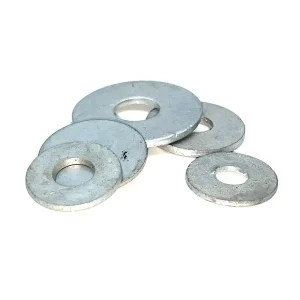
Combining independent flat washers with standard hex nuts introduces two friction interfaces ($Interface_1$: bolt/nut to washer, $Interface_2$: washer to joint surface). Under dynamic lateral loads, differential slip between separate washers triggers rapid self-loosening via Junker vibrational resonance.
The monolithic architecture of an oversized flange nut consolidates the load path into a single structural interface. This unified geometry eliminates relative friction slippage, reduces bill-of-materials SKU complexity by 50%, completely removes manual washer misplacement risks, and accelerates field assembly throughput by 35% on high-density production lines.
Slotted Hole Span & Bridging Capacity
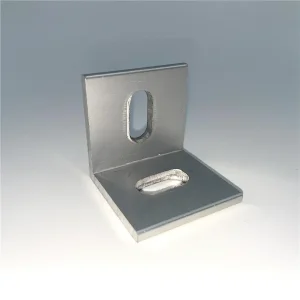
Photovoltaic mounting systems, pre-engineered building frameworks, and commercial chassis frequently employ oversized or elongated slotted holes (such as $14 \times 30\text{ mm}$ slots) to absorb field alignment tolerances and thermal expansion variations.
Standard hex fasteners pull into or dish these oversized apertures under high tensile preload, warping the joint and causing edge biting. The enlarged flange diameter of an oversized flange nut acts as an integrated structural bridge beam, uniformly spanning extended apertures without cupping, stress cracking, or localized bolt pulling.
Preload Formula & Torque Retention Dynamics
Clamping preload is governed by $T = K \cdot F_p \cdot d$, where $T$ is tightening torque, $K$ is the comprehensive nut factor, $F_p$ is axial preload, and $d$ is nominal thread diameter. Oversized flanges extend the mean friction radius ($r_m = \frac{d_w + d_h}{4}$). When paired with calibrated bearing serrations, this design creates a dual-slope friction profile: smooth, consistent running torque during tightening, combined with an engineered break-away torque 18% to 28% higher than installation torque during unseating.
Global Industrial Procurement Realities & Demand Drivers
How Tier-1 engineering procurement contractors (EPCs) evaluate fastener suppliers to secure supply chain resilience, total cost of ownership, and zero-defect installations.
Cost per Fastened Joint (TCJ)
Global procurement teams calculate the True Cost of Fastening (TCF) rather than piece-part invoice costs. Factoring in manual washer picking, washer drop losses in field sites, misaligned washer seating, and re-torquing post-commissioning, switching to one-piece oversized flange nuts drives an immediate 18% to 24% installed cost reduction across utility-scale operations.
Automated Robotic Feeding
Industrial assembly lines for commercial EV chassis, containerized battery energy storage systems (BESS), and HVAC compressor subassemblies require automated bowl feeder feeding. Standard nuts and separate washers produce frequent jams. Symmetrical, dimensionally controlled oversized flange nuts ensure 99.98% feeding uptime in high-speed magnetic-blow feed lines.
Batch Material Traceability
Critical infrastructure demands EN 10204 3.1 chemical analysis, ladle metallurgy tracing, and heat-treatment furnace telemetry. Handan Youlong Fastener maintains complete 100% heat-number lot tracking from raw steel wire rod coil down to individual carton barcoding, securing full traceability across the 25-to-30 year lifespans of critical assets.
Supply Chain Resiliency
Geopolitical supply shocks make sourcing from integrated industrial clusters vital. Handan Youlong operates in Yongnian District—the Fastener Capital of China—giving us direct access to upstream wire processing, cold-heading tool manufacturing, automated tapping lines, and hot-dip/zinc-nickel plating lines within a 15 km logistics radius.
Macro-Industry Engineering Solutions
Solving extreme structural challenges in renewable generation, marine infrastructure, transportation networks, and heavy machinery joints.
Utility-Scale Photovoltaics & Tracker Arrays
Single-axis solar trackers face continuous low-frequency aeroelastic flutter, vortex shedding, and dynamic wind buffeting. In tracker torque-tube clamps, bearing brackets, and purlin-to-rail junctions, standard nuts vibrate loose, causing drive failure and rail misalignment.
Handan Youlong supplies oversized serrated flange nuts coated with zinc-nickel or Geomet 500B. These fasteners bite through protective anodized layers on 6005-T6 aluminum or zinc patinas on hot-rolled steel, creating a permanent electrical bonding path for grounding while locking the joint securely under 160 km/h wind shear.
Wind Power Nacelle & Auxiliary Bracing
Wind turbine nacelles and yaw systems experience dynamic multiaxial cyclic fatigue. While main rotor hub studs use large tensioners, auxiliary assemblies—such as hydraulic manifolds, cable trays, service crane mounts, and nacelle cowlings—rely on threaded fasteners from M10 to M24.
Oversized flange nuts with engineered un-serrated bearing faces paired with disc springs distribute loads evenly without galling internal painted or thermal-sprayed surfaces. This approach preserves surface coatings, preventing localized corrosion and stress fractures across offshore turbine operational lifespans.
Commercial Vehicles, Rail & Heavy Earthmoving
Truck chassis side-members, rail bogie braking assemblies, and excavator counterweight mounts operate under constant road shock, stone impacts, and temperature cycling from -40°C to +85°C. Structural relaxation here risks rapid joint failure and catastrophic downtime.
High-tensile Grade 10 and Class 10.9 oversized flange nuts deliver maximum proof load resistance. Their wide flange profile spans hot-stamped chassis frame holes with controlled elasticity, retaining clamping preload even during torsional chassis twisting over rugged terrain.
Material Specifications, Mechanical Grades & Surface Coatings
Precise metallurgical alloy selection and advanced surface coatings ensure long-term integrity across harsh coastal (C5-M), desert industrial, and chemical environments.
| Material Category | Common Alloy / Grade | Tensile / Proof Load Class | Protective Finish / Surface | Neutral Salt Spray (NSS) | Target Operational Deployment |
|---|---|---|---|---|---|
| Austenitic Stainless | AISI 304 / A2-70 (1.4301) | Proof Load: 700 MPa | Passivated / Electro-polished | 500+ Hours (C3-C4) | Commercial rooftop PV, architectural building skins, solar carports. |
| Marine Stainless | AISI 316 / A4-80 (1.4401) | Proof Load: 800 MPa | Molybdenum Passivated | 1,500+ Hours (C5 Marine) | Offshore substations, floating solar (FPV), marine splash zones. |
| Cold-Heading Carbon | AISI 1035 / 10B21 Boron | ISO 898-2 Class 8 / 10 | Hot-Dip Galvanized (HDG) | 1,000 - 1,500 Hours | Utility ground-mount solar arrays, highway crash barriers, purlins. |
| Alloy Structural Steel | 35CrMo / 42CrMo4 | Class 10.9 / 12.9 / Gr.DH | Zinc-Nickel + Topcoat / Geomet | 1,500 - 2,000+ Hours | Wind turbine frames, heavy chassis joints, seismic steel trusses. |
| Specialty Coating | High Carbon 1045 | ASTM A563 Grade DH | PTFE Fluoropolymer / Xylan | 2,000+ Hours (Chemical) | Petrochemical flanges, wastewater treatment, acidic atmospheric sites. |
Zinc Flake (Geomet / Dacromet)
Non-electrolytically applied thin-film zinc and aluminum flakes deliver exceptional cathodic protection without the risk of hydrogen embrittlement. This coating is mandatory for high-tensile Grade 10 and 12 fasteners where acid pickling poses dangerous delayed fracture risks.
Zinc-Nickel (Zn-Ni) Alloy
Electroplated 12-15% nickel alloy deposits produce a uniform, ductile layer with exceptional surface hardness (up to 450 HV). This finish withstands repeated impact-tool installation without flaking, offering more than 1,500 hours of neutral salt spray protection against red rust.
Hot-Dip Galvanizing (HDG)
Applied to ISO 10684 standards with bath temperatures of 440-465°C, creating a metallurgical iron-zinc alloy layer with a minimum coating thickness of 45-65 μm. This delivers decades of sacrificial cathodic protection for exposed outdoor civil infrastructure.
Factory Direct Excellence: Handan Youlong Fastener
Combining the supply chain density of Yongnian—China's Fastener Capital—with multi-stage cold formers, automated optical sorting, and advanced laboratory testing.
Multi-Station Cold Heading
Our production facilities utilize modern multi-station high-speed cold heading formers (up to 6 stations). This allows complex oversized flange profiles, precision-shaped serrations, and recessed locking collars to be formed in a continuous grain-flow operation without breaking metallurgical lines, maximizing tensile resistance.
High-Precision Automated Tapping
Thread cutting is performed on high-precision CNC tapping systems holding 6H/6G ISO metric and 2B/3B ANSI thread limits. Oversize allowances for hot-dip galvanized mating (overtapping to DIN 267-27 / ISO 965-5) are precisely held to prevent thread seizure or excessive play during field installation.
100% Optical Sorting Lines
To support high-speed robotic assembly and automated bolting tools on EPC sites, our finished hardware passes through continuous high-resolution glass plate optical sorting machines. These verify pitch diameter, flange runout, serration depth, and thread completeness, maintaining an ultra-clean defect rate below 50 PPM.
Technical Roadmap & Fastening System Innovations
Anticipating structural engineering requirements across next-generation solar tracker arrays, lightweight battery enclosures, and automated robotic construction.
Embedded RFID & Smart Fasteners
Next-generation oversized flange nuts will feature integrated passive RFID microchips or specialized visual barcode etching on the flange perimeter. This enables handheld scanners or maintenance drones to verify batch pedigree, installation date, and initial torque records during annual solar plant and bridge inspections.
Next-Gen Micro-Encapsulated Adhesives
For applications where serration teeth cannot bite into coated or fatigue-sensitive surfaces, our engineers are validating pre-applied reactive anaerobic micro-encapsulated adhesive chemistry. Upon torque engagement, the capsules burst, providing both dynamic anti-loosening and environmental thread sealing to prevent internal galvanic corrosion.
Sustainable Green Steel Manufacturing
Youlong is transitioning raw material sourcing toward electric arc furnace (EAF) wire rod melted using low-carbon energy. By aligning with EU CBAM (Carbon Border Adjustment Mechanism) reporting guidelines, we empower global infrastructure developers to reduce their Scope 3 embodied carbon footprint.
Comprehensive Technical Q&A (FAQ)
Addressing the technical, mechanical, and logistical questions engineers, buyers, and QC directors evaluate before choosing an industrial fastener supplier.
Heavy-Duty Hardware & Renewable Structural Fasteners
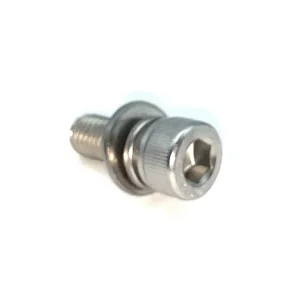
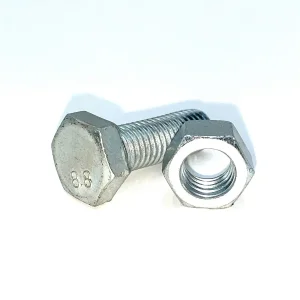
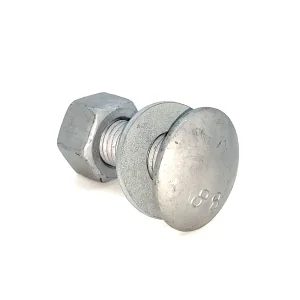
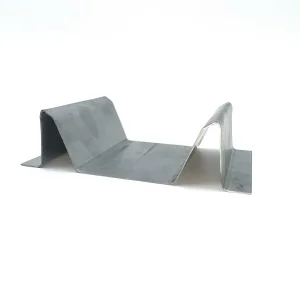
Precision-manufactured structural bolts, heavy-duty carriage assemblies, and guide rail profiles designed for reliable multi-decade field endurance.