
Featured Photovoltaic Hardware & Precision Mount Assemblies
Precision-machined structural anchors, rails, and fasteners engineered for extreme mechanical stability and long-term cyclic environmental durability.
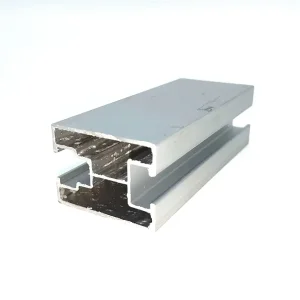
3040 Reinforced Aluminum Rail: Engineered 6005-T6 high-strength profile with optimized moment of inertia for heavy snow and high-wind structural loads.
View 3040 Guide Rail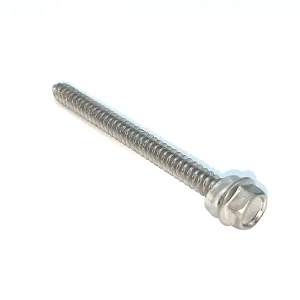
Stainless Steel Self-Drilling Screws: Bi-metal and hardened austenitic stainless steel with forged flute tips for fast sheet metal fastening.
View Self-Drilling Screws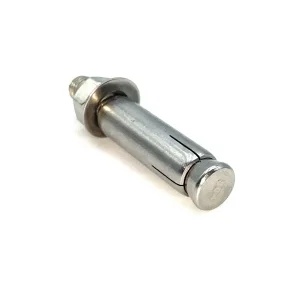
Heavy-Duty Concrete Expansion Bolt: High-retention mechanical wedge anchor for robust anchoring in uncracked and cracked structural concrete.
View Expansion Bolts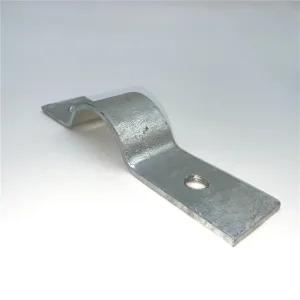
Adjustable Mounting Hoop Clamp: Heavy-duty 304/316 band clamp engineered for high-vibration pole fixtures and tubular structural joints.
View Mounting Hoop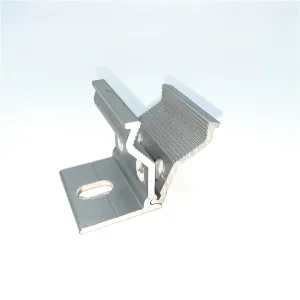
Klip-Lok Standing Seam Roof Clamp: Non-penetrating aluminum roof fastener eliminating roof perforation risks on commercial metal structures.
View Clip Lock Clamps
Precision Sharp Drill Point Screws: Engineered thread geometry delivering maximum pull-out resistance across light gauge steel and timber.
View Sharp Drill Point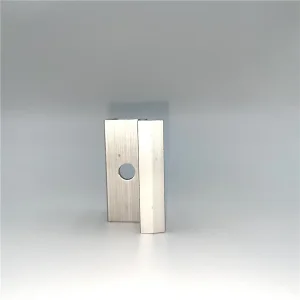
PV Module Aluminum End Clamp: Precision anodized aluminum clamping assembly with integrated grounding pins for PV perimeter retention.
View Panel Side Clamp
Zero-Drill PV Rooftop Interface Clip: High-friction clamped locking interface designed for zero-leak industrial solar roof conversions.
View No-Drilling ClipThe Fundamental Role of Galvanized Flat Washers in Bolted Joints
Demystifying clamping dynamics, interfacial embedment relaxation, and galvanic corrosion shielding across mission-critical civil and energy infrastructure.
In mechanical fastening design, the humble flat washer is frequently mischaracterized as a generic spacer. In reality, a high-specification galvanized flat washer (whether produced to DIN 125, ISO 7089, or ASTM F436/F436M) functions as an active mechanical boundary component. Its primary structural imperative is two-fold: First, to enlarge the compressive bearing footprint under the bolt head or nut, thereby mitigating Hertzian contact stress below the compressive yield point of the clamped substrate. Second, to normalize interfacial friction coefficients during torque application, ensuring that specified tightening torque translates faithfully into target clamp load (preload) without galling, surface gouging, or torsional deformation.
When outdoor civil engineering or utility projects fail prematurely, root-cause analyses regularly identify washer yielding, dishing (cupping), or catastrophic corrosion failure rather than core bolt shank fracture. Under prolonged dynamic loading—such as wind buffeting on photovoltaic solar arrays, heavy axle cyclic vibration on transportation corridors, or thermal expansions in high-voltage substation switchyards—an inadequate washer deforms plastically. This induces joint relaxation, loss of bolt clamping preload, and immediate fatigue vulnerability across the entire structural node.
Technical Insight: Mitigating Embedment Relaxation
Substrate embedment occurs when microscopic surface asperities yield under initial tightening pressure. Utilizing hardened structural washers (≥300 HV or quenched & tempered to ASTM F436) creates a rigid stress-distribution plane that prevents high-strength Grade 8.8, 10.9, or A325 fasteners from embedding into softer structural steels, preserving critical bolt elongation over decades of service.
Coating Comparative Architecture: HDG vs. Zinc-Flake vs. Electro-Plating
Selecting the appropriate sacrificial zinc deposition method based on atmospheric corrosion categories (ISO 9223 C1 to CX).
| Coating Process | Applicable Standards | Coating Thickness | Corrosion Endurance (B117 Salt Spray) | Hydrogen Embrittlement Risk | Ideal Application Sector |
|---|---|---|---|---|---|
| Hot-Dip Galvanizing (HDG) | ASTM A153 / ISO 10684 / EN ISO 1461 | 45 – 85 μm (320–600 g/m²) | 1,000 to 2,000+ Hours | Low (Relief baking required if >320 HV) | Utility Solar, Heavy Highway, Marine Piling |
| Mechanical Galvanizing | ASTM B695 Class 55 / ISO 12683 | 40 – 65 μm | 500 to 1,000 Hours | Zero (Non-electrolytic process) | High-Tensile Spring Washers & Clips |
| Zinc Flake (Geomet / Dacromet) | ISO 10683 / ASTM F1136 | 8 – 15 μm | 1,000 to 1,500+ Hours | Zero (Non-acidic chemical dip-spin) | Wind Turbine Towers, Automotive Powertrains |
| Electro-Galvanized (Zinc Plated) | ASTM F1941 / ISO 4042 | 5 – 12 μm | 72 to 168 Hours | High (Requires immediate de-embrittlement bake) | Interior Enclosures, Dry HVAC Ducting |
In hot-dip galvanizing, zinc does not simply adhere mechanically; it reacts metallurgically with the underlying carbon steel to form a series of distinct iron-zinc alloy layers:
- Gamma (Γ) Layer: A thin, extremely hard inner layer (75% Zn, 25% Fe) exceeding the hardness of the base steel itself.
- Delta (Δ) Layer: Dense columnar crystals (90% Zn, 10% Fe) providing primary barrier protection and abrasion resistance.
- Zeta (ζ) Layer: Monoclinic crystal formation (94% Zn, 6% Fe) acting as a tough impact-absorbing layer.
- Eta (η) Layer: The outer ductile zone consisting of 100% pure molten zinc, which provides cathodic sacrificial protection if the surface is scratched.
Localized Application Scenarios & Operational Case Studies
Engineered adaptations across diverse operational terrains—from corrosive marine tidal flats to high-seismic utility zones.
Utility-Scale Solar PV & Tracker Pivots
Ground-mounted arrays face high cyclic wind buffeting. In tracker torque-tube mounts, hot-dip galvanized ASTM F436 structural flat washers prevent slot deformation in slotted purlin brackets. Furthermore, they are paired with UV-resistant isolating sleeves or dielectric coatings to eliminate galvanic corrosion when bridging hot-dip galvanized steel pile caps and 6005-T6 aluminum rail sections.
Substation & HV Transmission Towers
High-voltage transmission structures encounter thermal cycles from sub-zero winters to blistering summers, alongside constant wind-induced micro-vibration. Standardized DIN 7989 heavy-series galvanized washers provide broad 8mm+ thickness profiles that maintain continuous axial tension on Grade 5.6 and 8.8 tower step and leg bolts, eliminating loose joint arcing.
Coastal & Offshore Marine Infrastructure
Operating in ISO 9223 C5-M / CX marine environments demands extreme zinc mass per unit area. Our heavy hot-dip galvanized washers undergo hot centrifugation with precise thermal timing, guaranteeing minimum 85 μm zinc thickness free from zinc thorns or edge buildup, ensuring flat-face clamping against marine dock bollards, piling brackets, and offshore wind transition pieces.
Preloaded Structural Steel (EN 14399)
In high-rise construction and seismic bracing frames, preloaded bolting systems (System HV and System HR) require specialized EN 14399-5 and EN 14399-6 chamfered flat washers. The chamfer ensures zero interference with the bolt head transition radius, allowing maximum tension load transfer without introducing localized stress concentrations.
Seismic Bracing & Heavy Vibratory Equipment
Heavy vibrating machinery, mining vibratory screens, and industrial blowers routinely shake non-hardened washers loose. By hardening washers to 38-45 HRC and applying precision electro-galvanized finishes with controlled molybdenum-disulfide lubricants, clamp torque conversion efficiency remains predictable even in severe operational shock regimes.
China Fastener Cluster Resilience: Yongnian Industrial Scale Advantage
Why direct procurement from the global fastener capital reduces procurement lead times, insulates against price shocks, and enforces quality repeatability.
Handan Youlong Fastener Co., Ltd. operates in Yongnian District, Handan City, Hebei Province—the indisputable "China Fastener Capital", which commands over 50% of China's national structural hardware manufacturing throughput. This geographical positioning creates unparalleled supply chain agility that cannot be replicated by decentralized regional producers.
Our raw materials (high-grade Q235B, 45# carbon steel, 40Cr alloy, and 304/316 stainless coils) are sourced directly from premier steel mills within an immediate 100-kilometer radius. Raw material billet pricing, slit-coiling, stamping, heat treatment, hot-dip galvanizing baths, and optical verification occur within an integrated, closed-loop ecosystem. This industrial proximity eradicates intermediate logistical bottlenecks, allowing our manufacturing floors to maintain continuous throughput and scale to 1,000+ metric tonne phased shipments with razor-thin production cycle times.
Continuous High-Speed Punch Presses
Equipped with 160-tonne to 400-tonne progressive automated multi-cavity punch presses operating up to 450 strokes per minute, producing high-concentricity flat washers with burr-free edges and zero shear tear.
Automated Centrifugal Galvanizing
Our automated hot-dip galvanizing lines incorporate programmable high-G centrifuges that expel surplus molten zinc before solidification, eliminating bore-clogging and uneven edge accumulation.
AI Laser & Optical Sorting
100% of aerospace and critical structural export batches undergo multi-camera laser optical sorting, screening for outer/inner diameter tolerance, thickness variation, surface defects, and dishing at sub-millimeter precision.
International Standards & Comprehensive QA Protocols
Ensuring cross-border compliance through accredited laboratory testing, traceability codes, and EN 10204 3.1 inspection documentation.
Global EPC contractors and tier-1 engineering firms cannot afford fastener failure on multi-gigawatt installations. Every production run at Youlong Fastener is cataloged through full heat-number traceability back to the steel melt shop. Our in-house quality inspection center executes rigorous testing protocols compliant with major international frameworks:
| Standard Specification | Dimensional & Mechanical Scope | Hardness Baseline | Compatible Structural Fasteners |
|---|---|---|---|
| ASTM F436 / F436M | Hardened Steel Washers (Imperial & Metric) | 38 to 45 HRC (Circular, Clipped, Extra-Thick) | ASTM A325, A490, A449, A354 Bolts |
| DIN 125A / ISO 7089 | Standard Flat Plain Washers (Form A without Chamfer) | 140 HV / 200 HV / 300 HV | ISO 898-1 Class 4.8, 8.8, 10.9 Hex Bolts |
| DIN 9021 / ISO 7093 | Large Outer Diameter Washers (3x Nominal Hole Diameter) | 100 HV / 200 HV | Wood framing, Sheet Metal, Solar Clamps |
| EN 14399-5 / EN 14399-6 | High-Strength Structural Preloaded Bolting Assemblies | 300 to 370 HV (HV / HR Systems) | EN 14399-3 (HR) & EN 14399-4 (HV) Assemblies |
| AS / NZS 1252.1 | High-Strength Steel Fastener Assemblies (Australasia) | 35 to 45 HRC | AS/NZS 1252 Structural Connections |
Certified Inspection Documentation
Shipments are dispatched with authentic EN 10204 Type 3.1 Mill Test Certificates detailing exact elemental chemistry (C, Si, Mn, P, S, Cr), Rockwell/Vickers hardness test results, magnetic induction coating thickness readings, and salt-spray chamber test logs to assure straightforward site engineering approval.
Technological Roadmap: The Next Era of Structural Joint Reliability
Anticipating higher solar tracker payloads, offshore green hydrogen platforms, and decarbonized green steel manufacturing.
Zinc-Aluminum-Magnesium (ZAM) Stamping
Adopting advanced ZAM pre-coated strip steels featuring self-healing edge characteristics. When stamped, molten zinc and magnesium salts migrate into sheared hole perimeters, offering superior edge protection with lower lifecycle carbon footprints than batch hot-dip baths.
Low-Embrittlement Chemical Formulations
Developing ultra-low hydrogen uptake pre-treatment acid alternatives, combined with automated inline vacuum baking ovens operating at 200°C–220°C for 8+ hours, preventing internal delayed hydrogen micro-fracturing across high-hardness structural washers.
Digitized RFID Batch Traceability
Piloting direct laser-etched 2D data-matrix codes on heavy structural washers to deliver instant on-site smartphone scanning for structural engineers verifying certificate authenticity, batch chemistry, and torque limits.
Technical Q&A: Frequently Asked Questions
Expert answers to complex queries regarding fastener pairing, coating selection, hydrogen embrittlement, and torque dynamics.
Why should hardened flat washers (ASTM F436) be used instead of standard DIN 125 washers with Grade 8.8 / 10.9 bolts?
Standard DIN 125 washers are typically stamped from soft, low-carbon steel (140 HV / 200 HV). When tightened with high-tensile fasteners (such as ASTM A325, Grade 8.8, or 10.9), the axial clamping force exceeds the yield strength of the soft washer. This causes the washer to dish, embed into the joint, and gall against the bolt face, leading to dramatic torque dissipation and subsequent bolt loose-off. ASTM F436 quenched and tempered washers (38 to 45 HRC) withstand extreme clamping forces without deforming, ensuring target tension retention throughout dynamic loading.
What is the mechanism of hydrogen embrittlement in galvanized flat washers, and how is it prevented?
Hydrogen embrittlement occurs primarily during acid pickling prior to electroplating or galvanizing, where atomic hydrogen diffuses into the steel's interstitial crystal lattice. Under stress, these hydrogen atoms migrate to micro-voids, creating catastrophic delayed brittle fracture. Youlong mitigates this risk through: 1) Utilizing mechanical blast cleaning instead of excessive acid pickling for high-strength steel; 2) Enforcing strict mandatory de-embrittlement baking at 200°C–220°C within 4 hours of electroplating; and 3) Performing periodic ASTM F1940 sustained load verification tests.
Can hot-dip galvanized flat washers be paired directly with aluminum mounting structures?
Direct interface between hot-dip galvanized steel washers and aluminum alloys (e.g., 6005-T6 or 6063-T5) is widely accepted in mild to moderate atmospheric conditions because the galvanic potential difference between zinc and aluminum is relatively narrow (~0.15V). However, in high-chloride marine environments (C5/CX) or industrial chemical zones, electrolytic moisture can trigger accelerated galvanic degradation of the zinc or aluminum perimeter. In such mission-critical applications, isolating non-conductive washers (EPDM or virgin nylon) or heavy zinc-nickel/dacromet coatings are specified to achieve dielectric isolation.
How does hot-dip galvanizing affect the internal diameter tolerances of flat washers?
Hot-dip galvanizing deposits a heavy molten zinc layer ranging from 45 μm to over 85 μm in thickness. Without specialized processing, molten zinc tends to puddle on inner diameters, restricting bolt shank insertion. Youlong solves this by employing high-speed centrifugal spinners immediately after bath exit and designing pre-galvanizing stamping punch dies with calibrated diametrical clearances that guarantee post-galvanizing compliance with standard bolt shank insertion tolerances (ISO 10684 / ASTM A153).
What is the standard packaging and logistics protocol for export shipments of industrial washers?
To prevent transit condensation (white rust) during prolonged ocean freight voyages, our export washers are sealed in heavy-duty 25 kg poly-lined woven polypropylene bags or corrugated boxes, stacked neatly on heat-treated, fumigated ISPM-15 wooden pallets, shrink-wrapped with waterproof stretch film, and reinforced with heavy steel or PET strapping. Full container loads (FCL) include container desiccant packs to actively absorb oceanic humidity.
Engineered Fasteners, Connectors & Bolting Products
Explore our complementary range of heavy-duty galvanized hex bolts, expansion fasteners, and purlin connectors engineered for integrated project procurement.
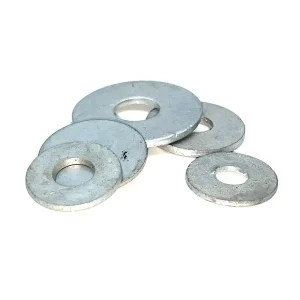
Stainless Steel Flat Plain Washers: Precision DIN 125/ISO 7089 washers manufactured in austenitic 304/316 for outstanding corrosion resilience.
View Flat Washers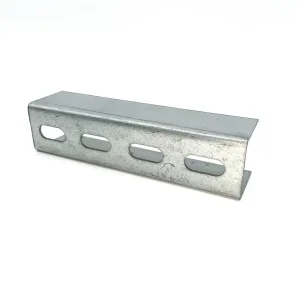
Adjustable Solar Purlin Connector: Stamped structural zinc-plated steel bracket designed for fast purlin-to-rafter alignment in ground-mount installations.
View Purlin Connector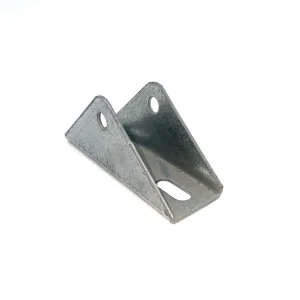
Three-Hole Structural Splice Plate: Heavy-gauge connector plate providing high bending resistance across longitudinal aluminum guide rail joints.
View 3-Hole Connector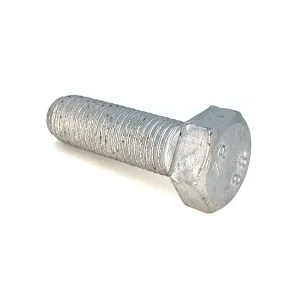
Heavy-Duty HDG Hex Structural Bolts: High-tensile Grade 8.8 / ASTM A325 fasteners with uniform 50μm+ zinc coatings for long-term outdoor engineering.
View HDG Hex Bolts
Corrosion-Resistant Concrete Wedge Anchor: Marine-grade stainless steel anchors optimized for ballast foundation blocks and foundation plates.
View SS Expansion Bolts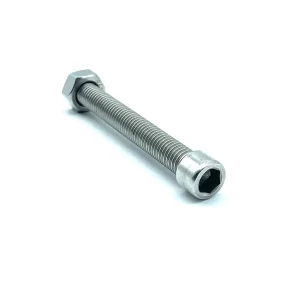
Stainless Steel Hex Socket Cap Screw: Precision DIN 912 socket screws providing sleek, low-clearance fastening in solar tracker bearing heads.
View Socket Cap Screws
3040 Heavy Aluminum Extrusion Rail: High torsional rigidity profile designed for extended span installations between commercial roof purlins.
View Reinforced Rail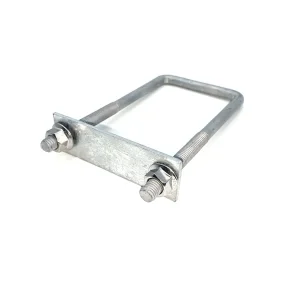
Dual-Hole Aluminum Pressure Clamping Plate: Heavy-gauge intermediate structural clamping plate ensuring uniform retention on frameless solar panels.
View Pressure Plate