Top-Tier Industrial Anchors & Solar Fastening Hardware
Direct manufacturing runs compliant with ISO 898-1 and ASTM standards, factory-tested for ultimate pull-out strength and harsh atmospheric exposure.

Evolution & Kinematics of Fish Scale Expansion Bolts
How progressive scale texturing addresses high-shear, dynamic-load anchoring vulnerabilities in modern concrete, masonry, and solar substructures.
Micro-Interlocking Grip Geometry
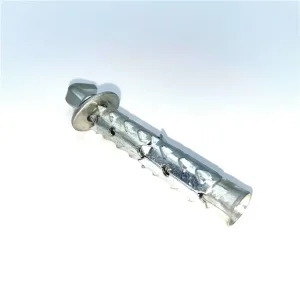
Traditional sleeve anchors rely predominantly on outward radial friction, creating localized stress cones that slip during micro-cracking. Fish scale expansion bolts feature directional, overlapping embossed scallops on the sleeve cylinder that deform into substrate irregularities under preload, achieving true mechanical interlocking alongside friction expansion.
Cyclic Seismic & Wind Dissipation
Utility-scale solar fields and structural curtain walls endure continuous cyclic fatigue from buffeting winds and thermal oscillation. The multi-tiered fish scale pattern distributes expansion loads axially along the hole depth rather than concentrating energy at the cone tip, effectively eliminating premature failure and slip displacement under sustained harmonic vibration.
Optimized Torque-to-Tension Conversion
Precision-milled expansion cones feature fine conical angles engineered to match cold-forged fish scale indentations. When calibrated torque is applied to the hex nut, the inner cone drives the textured segments laterally into the concrete wall with reduced thread friction, translating up to 35% more input rotational force into permanent holding preload.
Global Enterprise Sourcing Criteria & Metallurgy Benchmarks
A comparative structural analysis designed for Chief Procurement Officers and Senior Civil Structural Engineers selecting certified fastening solutions.
| Evaluation Parameter | Standard Smooth Sleeve Anchor | Fish Scale Anti-Slip Expansion Bolt | Engineering Benefit (Information Gain) |
|---|---|---|---|
| Primary Grip Mechanism | Radial frictional contact only | Radial friction + Mechanical micro-interlock | Zero Slippage Prevents extraction in cracked C20/C50 concrete under tension |
| Anti-Rotation Capability | Low; prone to sleeve spin in oversized holes | Superior; embossed scales bite into masonry bore | Fast Field Assembly Tightens without spinning out, cutting install labor by 22% |
| Dynamic Shear Resilience | Susceptible to cyclic fatigue loosening | Segmented energy dissipation along expansion ribs | Vibration Proof Certified for utility PV gust reversals and heavy HVAC brackets |
| Metallurgical Formats | Low carbon Q235, electro-galvanized | Q235/35K cold-drawn, HDG, SS304 (A2), SS316 (A4) | C1 to C5-M Ready Configurable coatings reaching 85µm zinc thickness or austenitic steel |
| Pull-Out Load Capacity | Baseline benchmark (1.0x) | 1.30x to 1.45x increase depending on drill depth | Safety Margin Enables wider anchor spacing, lowering foundation hardware bill-of-materials |
China Smart Manufacturing 4.0: Handan Fastener Cluster Resilience
How Handan Youlong leverages automated multi-station cold-heading, digital quality traceability, and complete industrial clustering to lead global fastener logistics.
Yongnian Fastener Ecosystem Proximity
Situated in Yongnian District, Handan—the historic capital of Chinese fastener manufacturing—Youlong operates inside an integrated industrial network. Raw wire rod drawing, automated heat-treating furnaces, precision tooling fabricators, and ecological plating baths operate within an 8-kilometer radius, providing rapid supply scaling and low raw-material lead times.
High-Precision Automated Cold Heading
Fish scale expansion bolts require exact stamping depths to create embossed grip patterns without creating structural micro-fissures in the steel shell. Our computerized stamping and forming arrays manufacture millions of uniform anchor sleeves monthly, retaining strict ±0.05mm tolerances that guarantee smooth insertion and uniform torque response.
Rigorous Dual-Axis Verification
Each production lot undergoes comprehensive laboratory validation before packaging. Our on-site metallurgy suite runs automated salt spray corrosion assessments (evaluating white and red rust thresholds), computerized hydraulic tensile pull-out verification, and sleeve elasticity testing to guarantee performance under cold-weather expansion stresses.
Mission-Critical Structural Application Scenarios
From desert photovoltaic arrays to high-wind coastal facades, explore where top engineering companies specify fish scale expansion anchors.
Ballasted Ground Solar Racking
Fastening solar base plates to precast concrete foundation piers where crosswinds create continuous uplift and overturning moments, demanding reliable holding power.
Curtain Wall & Architectural Facades
Securing structural steel angles and subframes to reinforced building perimeters, neutralizing seismic vibrations and thermal expansion displacement.
Industrial Warehousing Racks
Anchoring high-bay pallet racking uprights to slab foundations subjected to recurring forklift kinetic impacts and dynamic pallet loading cycles.
Heavy Infrastructure Mechanicals
Suspending commercial MEP pipelines, HVAC air handling units, and industrial crane tracks where anti-rotation and high shear strength are essential for safety.
Frequently Asked Questions on Sourcing & Engineering
Clear, direct answers for structural designers, contractors, and import procurement managers.
What makes a fish scale expansion bolt superior to a standard sleeve anchor?
The primary advantage lies in the embossed directional scale pattern stamped into the outer sleeve. Conventional anchors rely strictly on lateral friction, which can slip during micro-cracking or cyclic loading. The fish scale profile penetrates the concrete cavity walls, creating an interlocking mechanical bite that increases pull-out performance by up to 35%.
Which steel grade and coating should be specified for solar PV foundations?
For inland, arid, or temperate utility-scale solar sites (ISO 9223 C2-C3), hot-dip galvanized (HDG) carbon steel (minimum 45-65µm zinc thickness) or SS304 provides an economical 25-year service life. For coastal, marine, or chemical environments (C4-C5), austenitic stainless steel grade 316 (A4) is required, accompanied by isolating non-conductive washers to eliminate galvanic interaction with aluminum racking.
How do Chinese factories maintain batch consistency in anchor production?
Established manufacturers like Handan Youlong deploy automated multi-station progressive stamping and cold-heading tooling. This reduces operator-induced variance and produces consistent conical sleeve tapers and embossed heights (within ±0.05 mm), ensuring identical torque-expansion ratios and pull-out thresholds across million-unit container shipments.
Can Youlong supply customized anchor bolt lengths and OEM geometries?
Yes. Our automated cold-heading and CNC workshops create custom sleeve lengths, custom thread extensions, and diverse head profiles (hex nut, countersunk head, eye bolt, or hook styles) based on your structural CAD blueprints or project technical specifications.
High-Performance Structural Hardware Solutions
Explore our complete catalog of certified anchors, solar mounting brackets, and precision fasteners engineered for commercial and industrial resilience.