
China Top 10 Anchor Bolt Manufacturers for Global Buyers
China’s anchor bolt industry supports global construction, machinery, energy, and infrastructure projects. Its scale is significant. Grand View Research estimates that the global industrial fasteners market will continue expanding through 2030, driven by construction, automotive, and industrial equipment demand. Mordor Intelligence also identifies Asia-Pacific as a major fastener production and consumption region.
Yet production scale alone does not prove reliability. A dependable Anchor Bolt manufacturer must control steel sourcing, forging, threading, heat treatment, coating, and final inspection. Buyers should examine mill certificates, tensile-test records, dimensional reports, and traceability documents. These details matter when a bolt is installed beneath a steel column or exposed to coastal moisture.
Technical compliance requires equal attention. ISO 898-1 defines mechanical properties for carbon and alloy steel fasteners. ASTM F1554 applies specifically to anchor bolts used in structural applications. Other projects may require ASTM, DIN, EN, or customer-specific specifications. Therefore, this list of China’s top 10 manufacturers focuses on manufacturing capability, quality systems, export experience, customization, and documented compliance.
No ranking is flawless. Supplier performance can vary by batch, project, and inspection method. Global buyers should still verify factory qualifications, sample results, production capacity, packaging practices, and after-sales communication. A polished website is not evidence enough. Practical verification remains essential.
The following manufacturers are selected as credible candidates for international sourcing. Their strengths may differ, from high-volume standard production to customized heavy-duty assemblies. Buyers should match each supplier with the project’s load requirements, corrosion environment, certification needs, and delivery schedule. That approach is more useful than choosing by price alone.
China’s Anchor Bolt Manufacturing Industry and Global Market Role
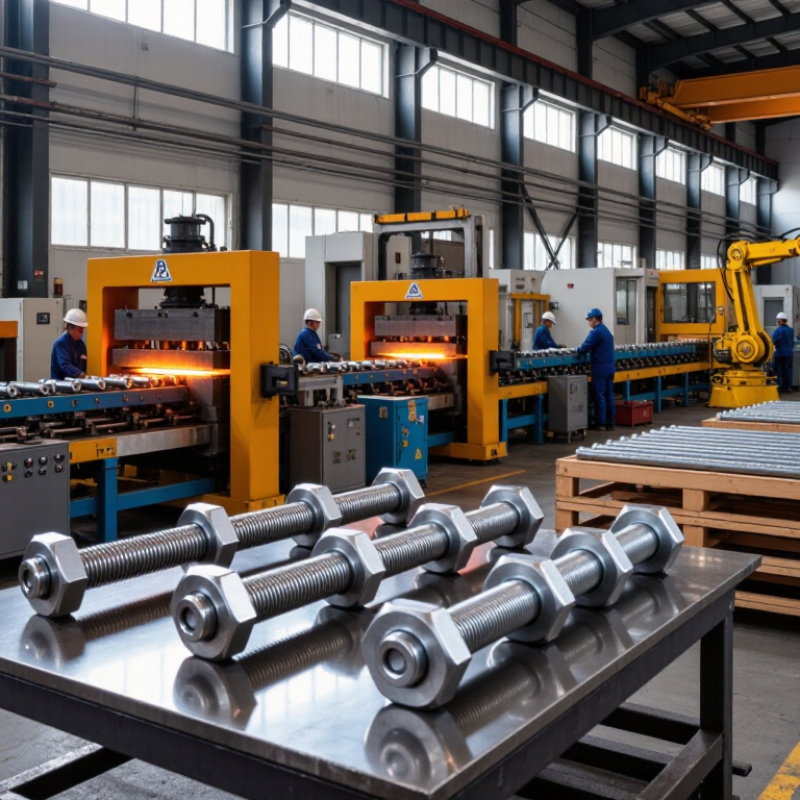
China’s anchor bolt manufacturing industry supports construction, energy, transport, and industrial infrastructure worldwide. Its top 10 manufacturers often compete through production scale, engineering control, and export experience. Manufacturing clusters provide access to steel mills, heat-treatment facilities, machining workshops, and testing laboratories. This connected supply base can shorten lead times and support customized orders.
Reliable manufacturers control every critical stage. They verify steel chemistry, thread dimensions, hardness, tensile strength, and coating thickness. Many buyers request compliance with ASTM, ISO, or EN requirements. Batch numbers, inspection reports, and material certificates improve traceability. Clear packaging also matters. Strong crates, moisture protection, and labeled bundles reduce damage during long ocean shipments.
The industry is not flawless. Some suppliers still depend too heavily on visual inspection or copied specifications. That creates avoidable risks in demanding projects. Buyers should review factory records, sample test results, and quality-control procedures before placing large orders. A capable supplier can explain load calculations, installation conditions, and corrosion concerns in plain language. Small details matter. For example, thread protection can prevent expensive site delays. China’s global role is growing, but trust must come from measured performance, not low prices alone.
China Top 10 Anchor Bolt Manufacturers for Global Buyers - China’s Anchor Bolt Manufacturing Industry and Global Market Role
| Industry Dimension | Verified Industry Data | Global Buyer Relevance | Common Reference |
|---|---|---|---|
| Primary Product Types | J-shaped, L-shaped, U-shaped, straight, bent, sleeve, and plate-anchor assemblies are commonly produced for concrete foundations and structural steel connections. | Buyers can match the geometry to foundation design, embedment depth, base-plate layout, and installation method. | Project drawings; engineering specifications; applicable national standards |
| Common Steel Grades | Carbon steel, low-alloy steel, and stainless steel are used. Frequently specified international grades include ASTM F1554 Grade 36, Grade 55, and Grade 105, together with ISO property classes such as 4.6, 8.8, and 10.9. | Material selection affects tensile strength, weldability, corrosion resistance, and compliance with structural calculations. | ASTM F1554; ISO 898-1 |
| Thread Systems | Metric coarse and fine threads are widely used in international projects; Unified inch threads are also available for North American specifications. | Thread diameter, pitch, tolerance, nut compatibility, and thread length should be confirmed before production. | ISO metric thread standards; ASME inch-thread specifications |
| Manufacturing Processes | Typical processes include steel bar cutting, hot forging or bending, machining, thread rolling or cutting, heat treatment where required, surface finishing, and inspection. | Process selection influences dimensional accuracy, grain flow, mechanical performance, lead time, and total cost. | Approved manufacturing procedure; inspection and test plan |
| Corrosion Protection | Hot-dip galvanizing, electroplating, black oxide, mechanical coatings, and stainless-steel construction are used according to exposure conditions. | Coating choice should reflect humidity, chlorides, soil chemistry, service life, and the risk of hydrogen embrittlement for high-strength fasteners. | ISO 1461; ISO 10684; project coating specification |
| Quality-Control Items | Routine controls may include chemical composition, tensile strength, yield strength, elongation, hardness, thread gauges, dimensions, coating thickness, visual inspection, and traceability. | Inspection records help buyers verify conformity and reduce installation, anchorage, and commissioning risks. | Mill test certificate; third-party inspection; EN 10204 inspection documents |
| Main Application Sectors | Applications include steel buildings, industrial equipment, bridges, transmission and utility structures, wind-energy foundations, rail projects, warehouses, and machinery bases. | Different sectors require different embedment, load, fatigue, corrosion, and installation requirements. | Structural drawings; foundation calculations; equipment installation manuals |
| Customization Capability | Custom orders commonly specify diameter, overall length, thread length, bend radius, plate dimensions, nut and washer combinations, material grade, coating, and packaging. | Detailed drawings and approved samples are important because anchor bolts are often project-specific rather than interchangeable. | Approved drawing; purchase specification; sample approval record |
| Export and Supply-Chain Role | China is a major global manufacturing and export base for steel fasteners and fabricated metal components, supported by extensive steel-processing, machining, coating, port, and logistics capacity. | Global buyers can source standard and engineered anchor bolts, consolidate related hardware, and arrange sea, rail, or air shipment according to project schedules. | Commercial contract; Incoterms® rules; export documentation |
| Buyer Selection Criteria | Key evaluation factors include applicable standards, material traceability, production capacity, dimensional control, coating quality, testing capability, packaging, delivery reliability, and technical communication. | A capability-based assessment is more reliable than comparing price alone, especially for safety-critical foundations and structural connections. | Supplier audit checklist; quality agreement; inspection plan |
FAQS
Check grade, diameter, thread accuracy, embedment length, and load capacity. Request material certificates and recent tensile test reports.
Traceable steel batches connect raw materials with finished bolts. Review heat-treatment records, coating thickness, thread gauges, and calibration dates.
A visit can reveal damaged dies, mixed cartons, or exposed threads. Small details often signal larger control problems.
No. Certificates support credibility, but they cannot prove consistent production. Verify their scope, issuer, validity, and recent test results.
Samples let you compare dimensions with drawings. Test thread fit using the actual nuts and templates.
Steel grade, diameter, length, threading, coating, order volume, tooling, freight, and port charges all affect cost.
Compare identical specifications. Ask for both factory and delivered estimates. A low price may hide thin coatings or weak inspections.
Request material certificates, dimensional reports, inspection photos, packing lists, and traceability codes. One paperwork error can delay a container.
Keep one signed file with the approved drawing, tolerances, coating requirements, and inspection plan. Late changes still cause mistakes.
Peak seasons can reduce control, and repeated batches may vary. I would recheck delivery records instead of trusting a polished presentation.
Conclusion
China has become an important source of anchor bolt products for construction, infrastructure, industrial equipment, and energy projects worldwide. Its manufacturing industry combines large-scale production, broad material availability, and increasingly advanced machining and testing capabilities. This overview explains how global buyers can evaluate leading Chinese manufacturers by examining production experience, engineering support, quality control systems, certifications, delivery reliability, and responsiveness to project requirements.
The profiles of the top ten manufacturers highlight differences in product range, including standard and heavy-duty designs, various steel grades, surface treatments, and customized dimensions. Buyers should also compare manufacturing tolerances, inspection procedures, packaging, export experience, lead times, and after-sales communication. Pricing depends on raw material costs, order volume, design complexity, coatings, tooling, and shipping arrangements, so the lowest quotation may not provide the best overall value. Careful supplier assessment and clear technical documentation can help international purchasers secure reliable products and long-term cooperation.
